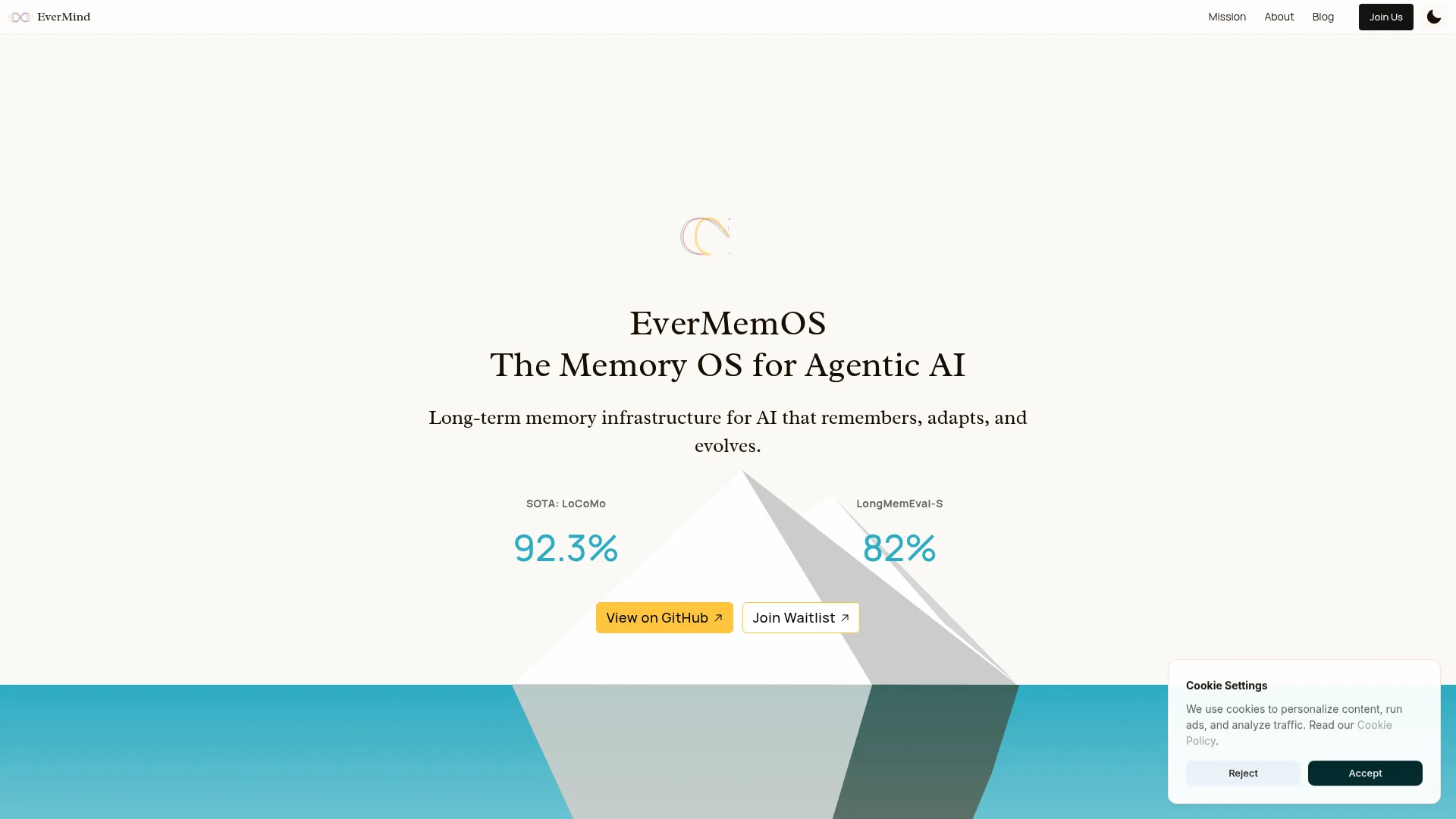
EverMemOS
Let assistants remember conversations and adapt to you.
Key Takeaways
- What it is
- Let assistants remember conversations and adapt to you.
- Best for
- Four-Layer Memory Design
- Structured MemCells and Multi-Level Memories
- Hybrid Retrieval and Agentic Recall
- Rating
- 4.3/5
What is EverMemOS?
EverMemOS is an open source “memory operating system” from EverMind that adds durable, structured long term memory to AI agents. It focuses on letting LLM based assistants remember past interactions, build evolving user profiles, and reason with context instead of treating every prompt as a clean slate. Under the hood it uses a four layer architecture that mirrors aspects of human cognition: an agentic layer for planning, a memory layer for storage and recall, an index layer for embeddings and key value search, and an API / MCP interface layer that plugs into external systems.
EverMemOS is unusual in that it treats memory as its own operating layer rather than a thin vector search add-on. Its MemCell design, multi level memories, and hybrid retrieval produce coherent “stories” about users and projects instead of disjointed snippets. Paired with EverMind’s dedicated benchmarks and research around long term memory, it occupies a focused niche: giving agents durable identities that grow over time while remaining inspectable and controllable by engineering teams.
EverMemOS offers a focused answer to a problem many teams now hit: agents that talk impressively yet forget almost everything. For organizations willing to run Docker and a small cluster of backing services, it provides a powerful, open, and testable way to add durable memory, coherent user profiles, and benchmarked long term reasoning to their AI stack. If the goal is agents that remember, adapt, and genuinely evolve with each interaction, this is one of the more serious options currently on the table.
Who is Using EverMemOS?
AI Infrastructure Teams in Tech Companies
Embedding EverMemOS as the shared memory layer that multiple internal agents query for user, project, and system context.
Product Teams Building Agentic Assistants
Powering copilots and chat assistants that must remember prior sessions, evolving requirements, and user preferences.
Customer Support Automation Providers
Using long term conversation and account history so bots respond with proper context instead of treating each ticket as isolated.
Research Labs and Academic Groups
Exploring long context reasoning, memory architectures, and evaluation using EverMemOS plus EverMemBench and related tooling.
Uncommon Use Cases
Utilized by digital therapeutics and wellness startups experimenting with emotionally consistent companion agents; Adopted by internal enablement teams that want HR or IT assistants to remember each employee’s prior interactions.
Key Features
Rating Breakdown
Pricing Plans
Open Source Core
- Free to use under the Apache 2.0 license for both personal and commercial self hosted deployments
Enterprise and Hosted Offerings
- Any managed services
- Enterprise support
- Or private deployments are handled directly with EverMind and do not have public price tiers as of now
Which EverMemOS plan should you pick?
Start with Free for hosted evaluation, use Community for unlimited self-hosting, upgrade to Pro for higher quotas and self-evolving skills, or choose Enterprise for custom limits and private deployment.
Community
Good for developers who need unlimited self-hosted memory spaces and full source-code access.
Free
Good for trying EverOS Cloud with three Memory Spaces and limited monthly usage.
Pro
Good for production experiments needing higher quotas, top-up packs, self-evolving skills, and priority email support.
Enterprise
Good for organizations needing custom quotas, dedicated account management, or private deployment.
EverMemOS Use Cases
Company knowledge base
Ingest internal discussions, documentation, and decisions into organizational memory.
Outcome: Creates an evolving institutional knowledge layer.
Customer support intelligence
Give support agents access to prior issues, resolutions, customer preferences, and communication style.
Outcome: Produces more personal and continuous support.
Personalized AI companion
Maintain long-term personal context and behavioral consistency across interactions.
Outcome: Creates a more consistent digital companion.
AI wearable with memory
Convert everyday conversations, visual cues, and voice commands into structured memory.
Outcome: Enables context-aware assistance across locations.
Family reunion matching
Use semantic matching to compare parents’ and children’s memories despite differing details.
Outcome: Helps families identify and verify potential matches.
Workflow Ideas with EverMemOS
Build a persistent agent memory loop
- 1Send messages, images, or documents to EverOS
- 2Let EverOS extract and classify memories
- 3Retrieve relevant context during agent responses
Self-evolve agent skills
- 1Record completed agent trajectories as Cases
- 2Distill repeated successful patterns
- 3Reuse the resulting Skills across the agent team
Self-host EverOS
- 1Clone the open-source repository
- 2Start the Docker services and install dependencies
- 3Configure environment variables and add the first memory
How EverMemOS fits into your stack
Browser
EverOS Cloud provides a browser-accessible managed environment for configuring memory spaces and API access.
Automation and APIs
The primary integration surface is the documented REST API and Python SDK for storing, retrieving, searching, and managing memory.
Desktop / IDE
EverOS supplies persistent memory for compatible coding agents such as Claude Code and Codex rather than acting as an IDE.
Knowledge and files
The multimodal ingestion layer parses PDFs, images, documents, spreadsheets, presentations, emails, HTML pages, text files, and URLs into retrievable memory.
Pros
- +True Long-Term Consistency: Helps agents maintain identity and context across days or months, instead of forgetting what the user said ten messages ago.
- +Open Source and Enterprise Ready: Apache 2.0 licensing and a transparent GitHub codebase suit security-conscious teams that want on-prem or VPC deployments.
- +Serious Benchmark Credentials: Strong results on LoCoMo and LongMemEval-S give technical buyers evidence that the memory system holds up under pressure, not just in demos.
- +Rich Retrieval Modes: From ultra fast BM25-only recall to multi round LLM-based retrieval, teams can tune latency, cost, and quality for each use case.
- +Good Getting-Started Experience: Quickstart scripts, sample data, and interactive chat demos make it practical to see the whole memory loop working in under an hour.
Cons
- −Nontrivial Infrastructure Footprint: Requires Docker plus MongoDB, Elasticsearch, Milvus, and Redis, which can feel heavy for small teams or hobby projects.
- −Early Ecosystem: Although maturing quickly, it still has fewer out-of-the-box integrations than established search or vector stores.
- −External LLM Dependency for Advanced Modes: Agentic retrieval relies on third party LLM APIs, so costs and latency depend on whichever model provider a team chooses.
Limitations & when to consider alternatives
Known limitations
- Profile semantic search is unavailable. Profile memory currently supports fetching by user ID and key only; semantic search is not supported.
- The v0 API is deprecated. New integrations should use the v1 API because the v0 API will be removed in a future release.
- Pro pricing is still in beta. The Pro plan is free during beta and is listed as $25 per month after launch.
- Cloud quotas apply. The Free cloud plan is limited to three Memory Spaces, 50,000 MCU monthly, and 100,000 retrieval API calls monthly.
- Self-hosting requires infrastructure management. The self-hosted path requires Docker services, dependencies, environment configuration, and local operational responsibility.
Look elsewhere when
- You need a native mobile application.
- You need model fine-tuning.
- You need SSO or SAML.
How to Use EverMemOS
- 1
Choose Cloud or self-hosted
Use EverOS Cloud for managed infrastructure, or deploy the Apache 2.0 stack on your own infrastructure.
- 2
Create an API key
Obtain an API key from EverOS Cloud and authenticate requests with a Bearer token.
- 3
Add memories
Send messages, images, documents, or other supported content through the memory APIs.
- 4
Retrieve context
Search personal, group, or agent memory and inject the returned context into your agent loop.
- 5
Use group memory
Create group resources and sender identities for multi-party or multi-agent memory spaces.
- 6
Enable skill evolution
Capture agent trajectories as Cases so repeated successful patterns can become reusable Skills.
Who is EverMemOS For?
Multi-agent systems
EverOS coordinates persistent memory across specialized agents working toward shared goals.
Personalized AI companions
Long-term memory supports consistent personalization, emotional context, and behavioral continuity.
Company knowledge bases
Organizations can turn discussions, documentation, and decisions into evolving institutional memory.
Customer support intelligence
Support agents can retain issue history, customer preferences, and communication context.
Wearable hardware builders
EverOS processes visual cues, voice commands, and fragmented interactions into structured memory.
Frequently Asked Questions
What is EverOS in one sentence?
EverOS is a self-organizing memory operating system that turns fragmented interaction histories into structured, evolving memory for AI agents.
How is EverOS different from classic RAG?
EverOS structures interactions, consolidates them into semantic themes, and reconstructs relevant context instead of only retrieving text chunks.
What does the engram-inspired lifecycle mean?
The lifecycle has episodic trace formation, semantic consolidation, and reconstructive recollection.
What is a MemCell?
A MemCell is an atomic memory unit bridging raw logs and higher-level semantics.
How does EverOS reduce memory hallucinations?
It combines atomic facts and metadata, consolidates contradictions, and retrieves minimally sufficient evidence.
Can EverOS handle 100k-plus conversation histories?
Yes. The FAQ says memory is chunked, indexed, and retrieved using multi-stage routing for large persistent stores.
Community reviews
Be the first to share your experience.
Sign in to leave a review for EverMemOS.
EverMemOS Alternatives
Looking for alternatives to EverMemOS? Here are similar tools in the same category: