Elicit
Revolutionizes academic research with AI, streamlining paper analysis and data synthesis.
Watch Elicit in Action
Key Takeaways
- What it is
- Revolutionizes academic research with AI, streamlining paper analysis and data synthesis.
- Pricing
- Freemium · $10 per month. billed annually
- Best for
- Database Access
- Summarization and Data Extraction
- Synthesis of Findings
- Rating
- 4.6/5
What is Elicit?
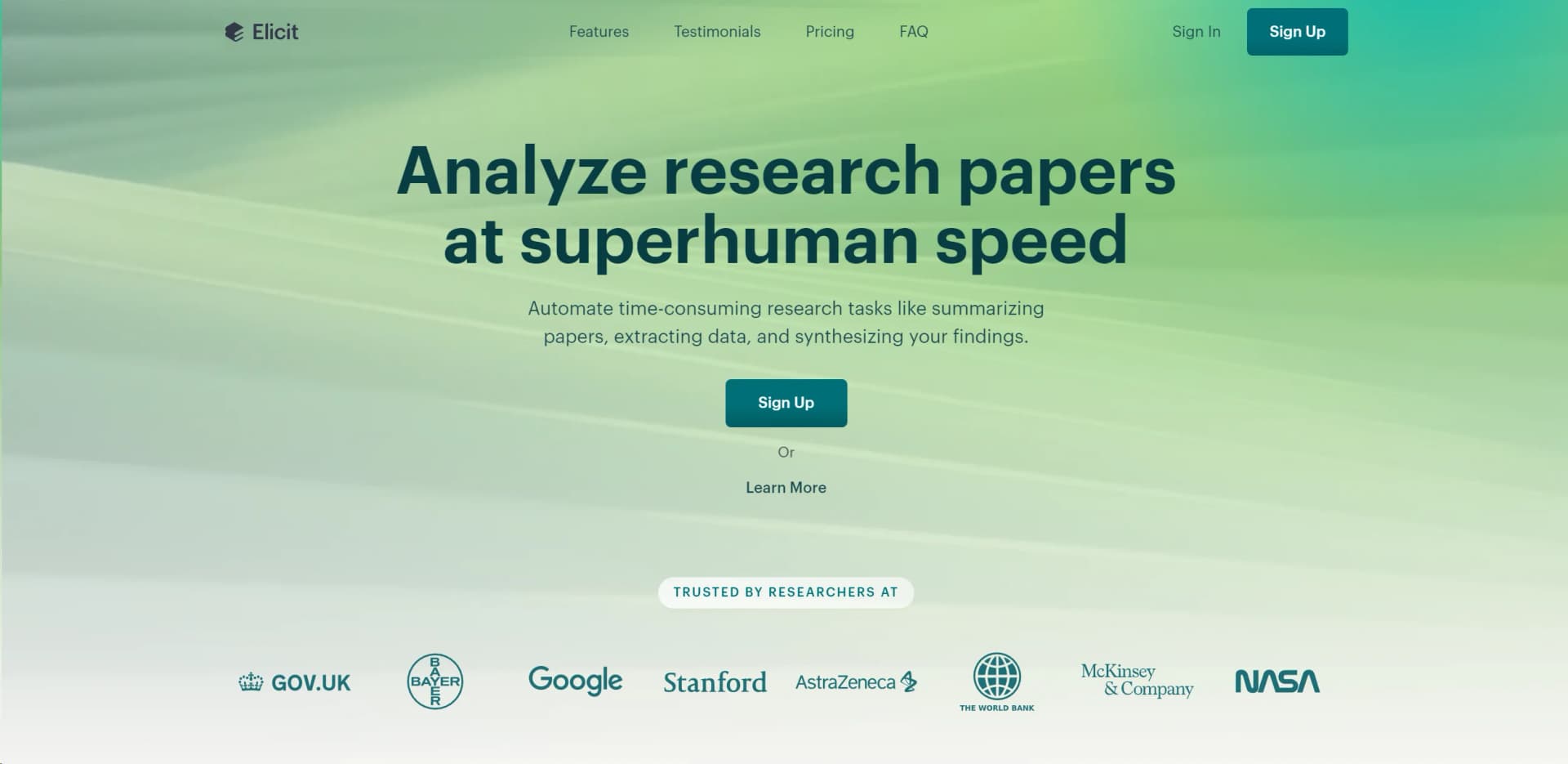
Elicit is an innovative AI research assistant designed to transform the way we interact with academic research. Its core functionality revolves around analyzing research papers at a speed and efficiency that seems superhuman. Aimed at researchers, academics, and professionals across various fields, Elicit simplifies the daunting tasks of summarizing papers, extracting crucial data, and synthesizing findings into coherent insights. By leveraging the power of AI, it stands as a revolutionary tool in the realm of academic research, making it an invaluable asset for anyone looking to streamline their research process.
Elicit distinguishes itself with its ability to search across an extensive database of academic papers using natural language queries. This feature, combined with its automated summarization and data extraction capabilities, positions Elicit as a pioneering tool in academic research. Its unique selling point lies in its efficiency and the significant time and cost savings it offers to researchers, making it an indispensable tool in the age of information overload.
Elicit excels in revolutionizing the academic research process, offering an unparalleled blend of speed, accuracy, and efficiency. Its ability to analyze research papers at superhuman speed, combined with its user-friendly interface and cost-effective solutions, makes it an essential tool for researchers and professionals across various domains. With Elicit, the future of academic research looks more accessible, enabling users to save time and focus more on deep thinking and innovation.
Who is Using Elicit?
Academic Researchers
Leveraging the tool for conducting literature reviews and synthesizing findings across numerous papers.
Biotechnologists
Employing Elicit for staying informed on the latest research developments in biotechnology.
Machine Learning Professionals
Using the tool to find relevant datasets and research papers in the fast-evolving field of machine learning.
Healthcare Professionals
Utilizing Elicit for researching medical issues and advancements.
Uncommon Use Cases
Utilized by policy analysts for gathering evidence-based insights; adopted by legal researchers for finding precedents and related academic discussions.
Key Features
Rating Breakdown
Pricing Plans
Free Tier
Free
- Explore what Elicit has to offer for free with 5,000 one-time credits
Plus Tier
$10 per month. billed annually
- Or $12 per month
- Billed monthly
Enterprise and Institutions
- Custom pricing is available for teams
- Companies
- Educational institutions
- Offering tailored solutions to meet their specific needs
Which Elicit plan should you pick?
Start with Basic for casual exploration, then upgrade when you need deeper research, systematic reviews, collaboration, enterprise controls, or API capacity.
Basic
Good for casual exploration and unlimited search, summaries, and paper chat with limited advanced usage.
Plus
Good for deeper research requiring exports, clinical-trial search, and standard advanced-workflow usage.
Pro
Good for systematic reviews, custom extraction, research alerts, report customization, and API access.
Scale
Good for teams needing live collaboration, figure extraction, larger research workloads, and administrative controls.
Enterprise
Good for companies and schools needing SSO, SAML, custom deployments, security controls, custom data sources, and unlimited API access.
Elicit Use Cases
Search scientific literature
Ask a natural-language research question and retrieve relevant papers using semantic search.
Outcome: A ranked set of relevant academic sources.
Generate research reports
Create structured, cited literature reviews from selected papers.
Outcome: A research brief or literature review with traceable citations.
Run systematic reviews
Screen studies and extract structured data using a dedicated systematic-review workflow.
Outcome: A reproducible review process with screening and extraction results.
Analyze research evidence
Search literature, extract data, analyze tables and figures, model data, and create charts.
Outcome: Decision-ready insights from complex evidence.
Monitor new research
Create personalized alerts for useful searches and follow newly published research.
Outcome: Ongoing awareness of relevant research developments.
Workflow Ideas with Elicit
Build a literature review
- 1Ask a research question using natural language
- 2Review and refine relevant papers
- 3Generate a cited research report
Conduct a systematic review
- 1Upload or search for papers
- 2Screen studies using custom criteria
- 3Extract data and review the final results
Create a living review
- 1Complete an initial systematic review
- 2Set up research alerts
- 3Update the review as new papers are published
How Elicit fits into your stack
PDF Uploads
Users can upload their own PDFs for analysis, making it a versatile tool for personal research libraries.
Export Options
Elicit Plus allows exporting results to RIS, CSV, and BIB formats, facilitating integration with other research tools and software.
Natural Language Processing
Leveraging advanced NLP, Elicit integrates seamlessly with the research workflow, interpreting complex queries with ease.
Pros
- +Time-Saving: Elicit has been reported to save users up to 5 hours per week by automating research tasks that are typically time-consuming.
- +Cost-Effective: Pilot projects have demonstrated Elicit's ability to cut research groups' costs and time by 50% through automation of data extraction tasks previously done manually.
- +Highly Accurate: Though not perfect, Elicit strives for high accuracy in its outputs and provides sources for verification, fostering trust in its synthesized findings.
- +Flexible and Accessible: With options for both free and paid plans, Elicit is accessible to individual researchers, teams, and institutions, offering tailored solutions to meet diverse research needs.
Cons
- −Learning Curve: New users may require some time to familiarize themselves with the tool's advanced features and full capabilities.
- −Limited to Empirical Research: Elicit is optimized for empirical domains involving experiments and concrete results, which may limit its applicability in theoretical or non-empirical areas.
- −Accuracy Concerns: While Elicit aims for high accuracy, the reliance on AI means that users should verify the synthesized information, which could add an extra step to the research process.
Limitations & when to consider alternatives
Known limitations
- English-language optimization. Search, summaries, and data extraction are optimized for English-language papers; quality for other languages varies.
- Figure extraction is plan-limited. Basic and Pro read text and tables only; figures, charts, and diagrams require Scale or Enterprise.
- Table extraction can fail. Elicit may fail to extract information from tables depending on their complexity and formatting.
- API access requires a paid plan. The API requires Pro, Scale, or Enterprise access, with limits determined by plan tier.
- Academic evidence focus. Elicit works best with information written about in academic papers and is less suitable for unsupported factual or non-empirical questions.
How to Use Elicit
- 1
Explore comprehensive tutorial series available on the Elicit website, covering everything from basic setup to advanced features, ensuring users can maximize the tool's potential.
Who is Elicit For?
Academia
Academic researchers can search, synthesize, and review scientific literature with citations and structured extraction.
Pharmaceuticals
Pharmaceutical teams can analyze evidence, prioritize targets, and accelerate literature reviews.
Medical devices and technology
Medtech teams can support evidence-based product and technology decisions.
Policy and government
Policy researchers can synthesize evidence for rigorous, evidence-based policymaking.
Software and technology
Technology teams can investigate algorithmic performance, user experience, and related research questions.
Frequently Asked Questions
What data sources does Elicit search?
Elicit searches academic papers, clinical trials, structured biological databases, regulatory databases, patents, web sources, conference abstracts, and commercial data sources.
Can I upload my own data?
Yes. Elicit supports uploaded documents and files including BibTeX, EndNote, Mendeley, PDF, and Zotero formats.
Can Elicit extract information from figures?
Figure, chart, and diagram extraction is available on Scale and Enterprise plans; Basic and Pro read text and tables only.
Can I collaborate with teammates?
Scale supports live editing and real-time collaboration, while Enterprise adds broader security and administrative controls.
Is Elicit free?
Yes. The Basic plan is free and includes unlimited paper search, summaries, and paper chat, with limited Research Agent and Research Reports usage.
Does Elicit support languages other than English?
Elicit is optimized for English-language papers. Other-language queries may work, but quality varies and translation is not its intended use.
Community reviews
Be the first to share your experience.
Sign in to leave a review for Elicit.
Elicit Alternatives
Looking for alternatives to Elicit? Here are similar tools in the same category: