Distributional
Production testing that helps enterprise teams catch changing AI behavior.
Key Takeaways
- What it is
- Production testing that helps enterprise teams catch changing AI behavior.
- Pricing
- Freemium · $99 per month
- Best for
- Similarity Index
- Key Insights
- Adaptive testing
- Rating
- 1.5/5
What is Distributional?
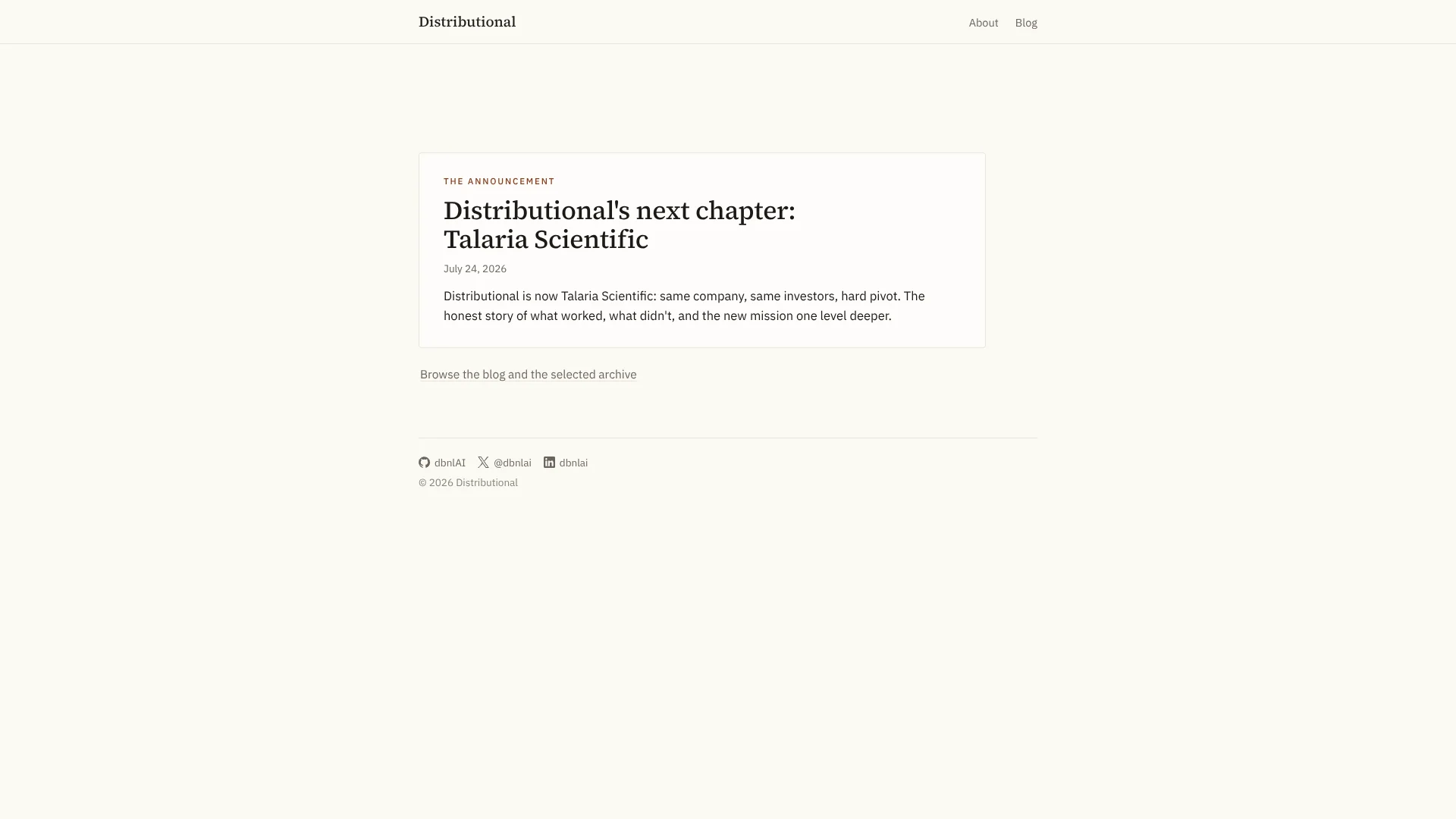
Distributional was an enterprise product for testing whether AI applications behaved consistently as they changed and encountered real user activity. AI product and engineering teams used it to examine application logs and traces, compare behavior over time, and investigate changes that ordinary spot checks could miss. The company says the product has been sunset, so this description is a record of its former offering, not a recommendation to sign up.
Its Similarity Index summarized behavioral change at the application, data-column, and metric levels, while Key Insights described what had shifted and why it might matter. That combination was designed to connect a high-level signal about an AI app with specific evidence teams could investigate.
The archived material is most relevant to enterprise AI teams researching production testing and behavioral analytics. Distributional is now Talaria Scientific, and the former product is no longer offered; readers looking for a tool to adopt today should treat its feature descriptions as historical.
Who is Using Distributional?
AI product engineers
Production behavior comparisons were intended to help them identify and investigate changes in AI applications.
AI platform engineers
The archived platform materials describe connecting application data sources for batch analysis.
Machine learning engineers
Adaptive tests were designed to compare AI application behavior across baselines and experiments.
AI quality and testing leads
Similarity Index and Key Insights were intended to make behavioral changes easier to detect and interpret.
Uncommon Use Cases
Comparing agent versions during an A/B test; investigating whether a change in user feedback tracks with changes in agent behavior.
Key Features
Rating Breakdown
Pricing Plans
Free Tier
Free
- Start with Distributional at no cost to explore its functionalities
Pro Tier
$99 per month
Distributional Use Cases
Spot changes in production AI behavior
A comparison of application data over time was intended to surface shifts that a fixed set of test examples might miss.
Outcome: A signal showing whether behavior changed and where to investigate.
Investigate agent issues
Production traces and behavioral insights were used in archived examples to narrow down possible causes of an agent problem.
Outcome: A faster path from an observed issue to a potential root cause.
Compare agent versions
Archived examples show teams comparing versions and checking whether a fix changed the agent’s behavior.
Outcome: Evidence for whether the tested change improved the observed behavior.
Workflow Ideas with Distributional
Review a behavior change
- 1Compare a recent run with a baseline.
- 2Check the Similarity Index for an overall change signal.
- 3Review Key Insights and the related metrics to investigate the change.
Check an agent fix
- 1Separate the runs for the original agent and the updated version.
- 2Compare their production behavior.
- 3Review the results to see whether the change addressed the observed issue.
How Distributional fits into your stack
AI logs and traces
The former product analyzed application data such as logs and traces to assess AI behavior. Its archived materials describe multiple data-ingestion approaches.
Production testing and analytics
Distributional’s archived workflow connected behavior comparisons with insights intended to help teams investigate changes in production AI applications.
Existing AI environments
Archived technical material describes deployment within existing environments, including cloud and virtual private cloud setups.
Pros
- +Behavior-change focus: Its former testing approach examined shifts across application data, not only individual responses.
- +Explainable signals: Key Insights were designed to describe what changed and connect findings to detailed metrics.
- +Production context: Archived examples show analysis of AI logs and traces, including agent behavior.
Cons
- −No longer available: The product has been sunset, so teams cannot adopt it as a current service.
- −Specialized approach: Its former focus was production AI testing and analytics, not general AI content creation.
Limitations & when to consider alternatives
Known limitations
- The product has been sunset. Distributional’s official announcement says the former product was discontinued as the company changed direction to Talaria Scientific.
Look elsewhere when
- You need an AI testing or analytics product that is currently available.
How to Use Distributional
- 1
Explore the extensive range of tutorials on the official website, covering everything from basic setup to advanced data management techniques.
Who is Distributional For?
Enterprise AI teams
The archived product was aimed at teams seeking repeatable ways to assess AI application behavior in production.
AI product teams
Its former analytics workflow was intended to help teams investigate and improve AI agents using production data.
AI platform teams
Distributional’s archived materials describe fitting its testing and analytics into existing AI environments.
Frequently Asked Questions
Can I sign up for Distributional today?
No. The company says the Distributional product has been sunset.
What did Distributional do?
Its former product analyzed AI application data to detect and investigate changes in behavior over time.
What is Distributional now?
The company announced that it is now Talaria Scientific, with a new direction focused on tools for computational science.
What did the Similarity Index show?
It summarized behavior changes at application, data-column, and metric levels.
Community reviews
Be the first to share your experience.
Sign in to leave a review for Distributional.
Distributional Alternatives
Looking for alternatives to Distributional? Here are similar tools in the same category: