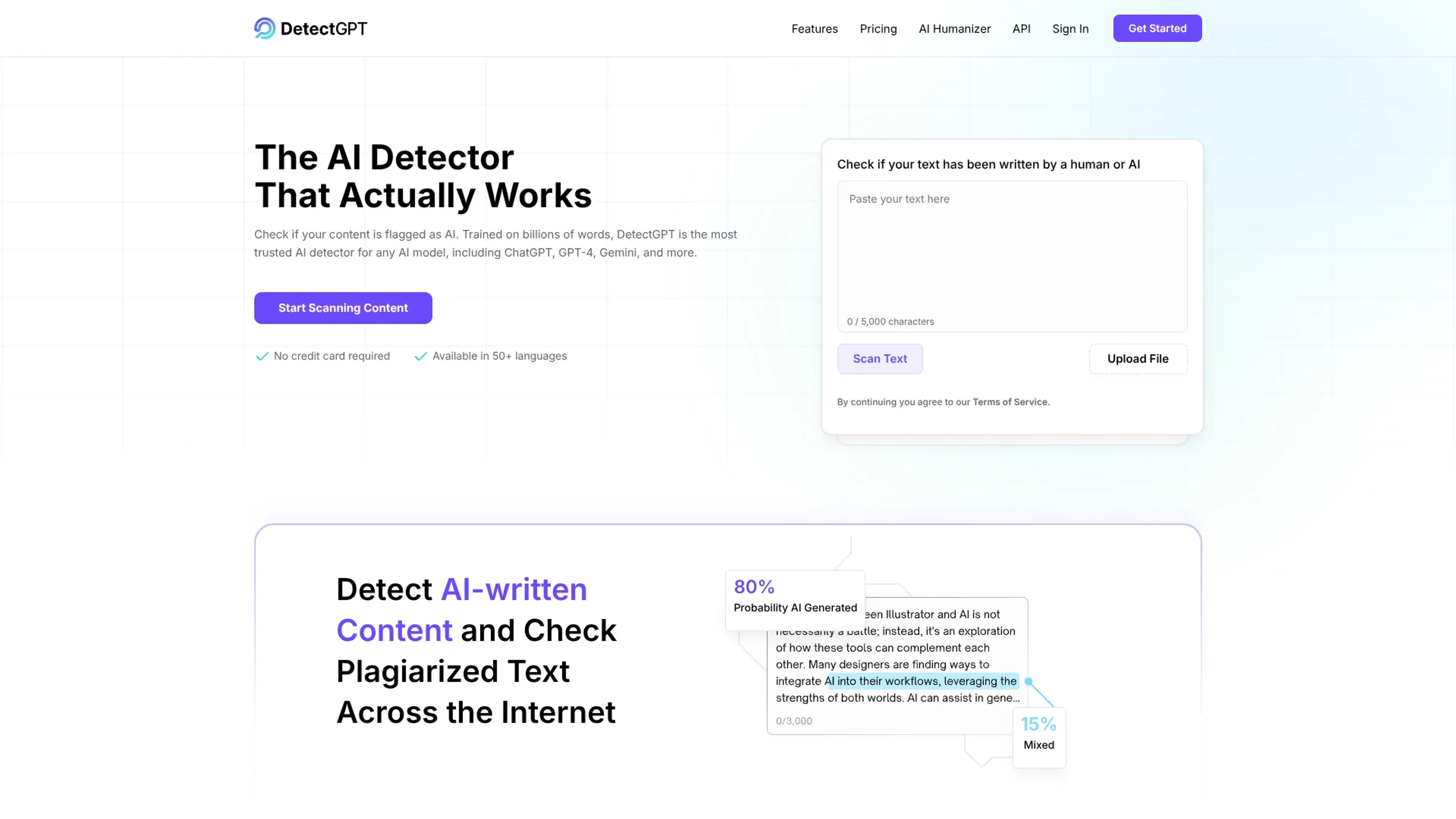
DetectGPT is an AI detector and AI humanizer focused on telling human writing apart from text generated by large language models such as ChatGPT, GPT‑4, Gemini, Claude, and others. It analyzes text for AI‑like patterns, plagiarism, factual accuracy, and readability, while also offering tools to rewrite AI content so it appears human written. The product targets educators, students, writers, and organizations that care about content authenticity, but also those who need to reduce the chance of being flagged by AI detectors.
Key Features:
AI Text Detection Across Models: Classifies text as human, AI, or mixed and provides probability scores, trained on billions of words and tuned for modern models like GPT‑4 and Gemini.
Original Content Certification: Issues human‑written certificates and shareable analysis links so agencies, freelancers, and publishers can prove authorship to clients and stakeholders.
Plagiarism, Fact Check, and Readability: Built‑in plagiarism checks against online sources, basic fact verification, and readability scoring to strengthen the integrity and clarity of each piece.
AI Content Humanizer: Rewrites AI‑generated text to preserve meaning while altering style and structure, aiming to bypass AI detectors, including its own.
Multi‑Language Support: Works in 50+ languages, helpful for global classrooms and international content teams.
File and Batch Processing: Upload documents and run batch scans (with quotas based on plan) plus export PDF reports for audit trails and compliance.
AI Detection & Humanization API: REST API to embed detection and humanization directly into custom platforms, LMSs, or internal tooling.
Pros
Strong Detection Pedigree: Built on research about model log‑probability curvature, giving it a more technical foundation than many “black box” detectors.
End‑to‑End Content Workflow: Covers detection, plagiarism scanning, readability, and certification in one place instead of stitching together several tools.
High Volume Friendly: Generous word limits and batch processing suit agencies, universities, and content teams handling lots of documents.
API for Developers: Easy integration into existing workflows, portals, or moderation pipelines.
Language Coverage: 50+ languages makes it useful well beyond English‑only environments.
Cons
Potential for Misuse: The AI humanizer explicitly aims to bypass detectors, which raises ethical and policy concerns in education and hiring.
Detection Is Not Perfect: Vendor claims of 95–99% accuracy should be treated as indicative, not absolute, especially on short or heavily edited text.
Limited Transparency on Data Handling: Public materials do not deeply detail how long uploaded content is stored or how it is secured, which larger enterprises may question.
Who is Using DetectGPT?
Educators and Academic Institutions: Checking essays and assignments for AI use, plagiarism, and readability while documenting results via PDF reports.
Students and Researchers: Verifying originality before submission and stress‑testing drafts against AI detection policies.
Content Writers and SEO Agencies: Auditing blog posts, landing pages, and client copy for originality, then issuing authenticity certificates.
Businesses and HR Teams: Screening reports, applications, and test assignments for AI‑generated sections.
Uncommon Use Cases: Used by compliance teams to document authorship trails for regulated communications; adopted by AI tool builders who embed the API as a content‑moderation layer.
Pricing:
Essential: $15 per month; includes 50,000 words per month, 1 user seat, premium AI detection models, batch file detection (10 files), PDF report generation, AI Content Humanizer, and plagiarism checker.
Pro: $29 per month; includes 250,000 words per month, 3 team members, premium AI detection models, batch file detection (20 files), PDF report generation, AI Content Humanizer, and plagiarism checker; free trial available.
Team: $59 per month; includes 500,000 words per month, unlimited team members, premium AI detection models, batch file detection (50 files), PDF report generation, AI Content Humanizer, and plagiarism checker.
Disclaimer: Please note that pricing information may not be up to date. For the most accurate and current pricing details, refer to the official DetectGPT website.
What Makes DetectGPT Unique?
DetectGPT originated from academic work on detecting AI text by comparing how likely the original text is under a model versus perturbed versions. That research‑driven approach gives the detector a more principled signal than keyword heuristics alone. The combination of serious detection tools, shareable authenticity certificates, and an aggressive AI humanizer in one product is quite unusual. It effectively serves both sides of the authenticity story: those who want to catch AI text and those who want AI drafts to pass as human, which is exactly where many of today’s content battles are happening.
How We Rated It:
Accuracy and Reliability: 4.4/5
Ease of Use: 4.6/5
Functionality and Features: 4.5/5
Performance and Speed: 4.6/5
Customization and Flexibility: 4.2/5
Data Privacy and Security: 4.0/5
Support and Resources: 4.0/5
Cost-Efficiency: 4.3/5
Integration Capabilities: 4.1/5
Overall Score: 4.3/5
Research‑Backed AI Detection For A World Full Of Synthetic Text
DetectGPT gives schools, writers, and businesses a technically grounded way to test whether content looks AI‑generated, while also catering to users who want AI drafts to survive detector scrutiny. Its mix of probabilistic detection methods, detailed reporting, certificates, and API access makes it appealing for serious authenticity workflows. At the same time, the presence of a powerful AI humanizer means organizations should set clear policies around how and when it is acceptable to use, especially in academic or hiring scenarios. For teams that need both detection and transformation of AI content in a single, AI‑centric tool, it is a strong contender worth evaluating.