
DeepKeep
Enhances AI security, detects risks, automates remedies.
Key Takeaways
- What it is
- Enhances AI security, detects risks, automates remedies.
- Best for
- AI-Native Security
- Continuous Risk Detection
- Automated Remedies
- Rating
- 4.5/5
What is DeepKeep?
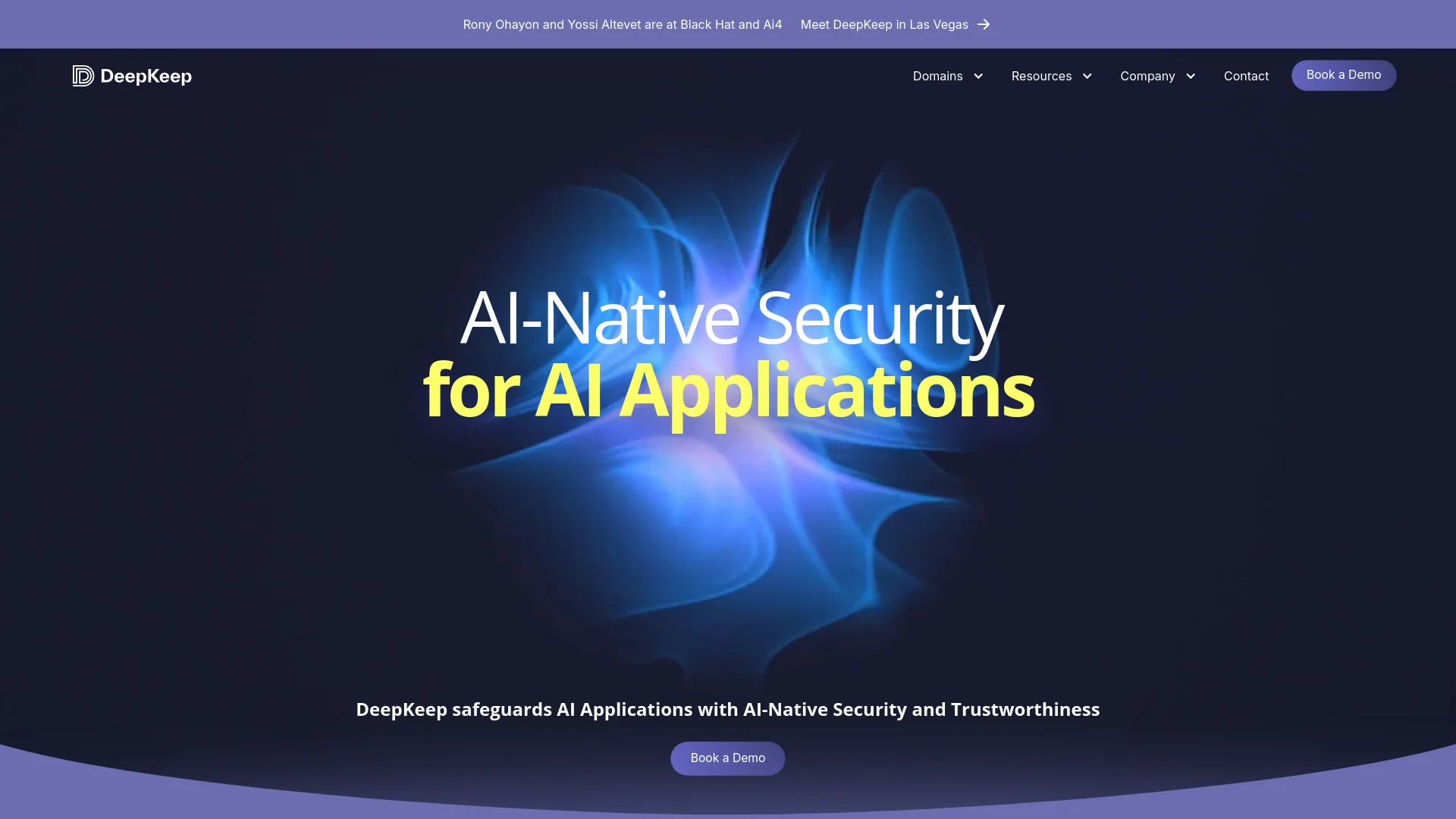
DeepKeep is an advanced AI tool specifically designed to enhance security and trustworthiness within AI applications. It stands out in the tech landscape as the only generative AI-built platform that not only identifies both seen and unseen vulnerabilities across the AI lifecycle but also offers automated security and trust remedies. This makes DeepKeep an essential asset for businesses relying heavily on AI, GenAI, and LLM technologies to safeguard their operations against a range of cyber threats and compliance risks.
DeepKeep distinguishes itself by being the only AI-native security platform that comprehensively understands and mitigates the intricacies of AI and LLM technologies. Its ability to foresee and protect against both predictable and unpredictable risks sets it apart in the market.
DeepKeep excels in providing cutting-edge security solutions tailored for AI applications, making it an indispensable tool for large enterprises and sectors that heavily rely on AI technologies. Its unique AI-native approach, coupled with dynamic and comprehensive protection capabilities, offers unmatched advantages in safeguarding AI-driven operations.
Who is Using DeepKeep?
Financial Institutions
Employing DeepKeep to protect AI-driven operations and customer data.
Automotive Companies
Using the tool to secure AI functionalities in autonomous vehicles.
Insurance Firms
Leveraging AI-native security to evaluate risks and manage claims more securely.
AI Computing Sectors
Integrating DeepKeep for enhanced security in complex AI computations.
Uncommon Use Cases
Academic institutions use DeepKeep for research in AI safety; cybersecurity firms utilize it for training on AI risk management.
Key Features
Rating Breakdown
Pricing Plans
Custom Pricing
- DeepKeep offers tailored pricing based on the specific needs and scale of the business
DeepKeep Use Cases
Secure AI applications
Apply runtime guardrails, red teaming, and monitoring to customer-facing AI products.
Outcome: Reduced AI application risk and stronger compliance evidence.
Protect autonomous agents
Scan agent workflows, connected tools, data access patterns, and privilege boundaries.
Outcome: Greater visibility into agent attack surfaces and unauthorized actions.
Govern employee AI usage
Monitor AI tool use, control model access, and inspect prompts and responses.
Outcome: Centralized control over organizational AI usage.
Workflow Ideas with DeepKeep
Automated AI red-team regression testing
- 1Connect DeepKeep to CI/CD pipelines via APIs
- 2Run automated regression tests against the AI system
- 3Review vulnerability findings and remediation guidance
Runtime AI firewall enforcement
- 1Route AI traffic through the DeepKeep AI Firewall
- 2Evaluate prompts, responses, and tool interactions against policies
- 3Allow, block, redact, or alert on risky interactions
How DeepKeep fits into your stack
API Access
DeepKeep's APIs allow for seamless integration with existing corporate systems.
Multi-Modal Support
Compatible with various AI models, enhancing its adaptability.
Real-Time Updates
Integrates with systems to provide real-time security updates and risk assessments.
Pros
- +Enhanced Trustworthiness: Builds higher trust in AI applications by managing and mitigating risks effectively.
- +Dynamic Protection: Adapts to new threats in real-time, providing protection that evolves with the AI landscape.
- +Comprehensive Coverage: From R&D through the entire product lifecycle, ensuring end-to-end security.
- +Support for Multimodal AI: Secures a range of AI models including LLM, vision, and tabular data.
Cons
- −Complexity: The advanced features may require a steep learning curve for teams not already versed in AI security.
- −Resource Intensity: May require significant computational resources to run effectively.
- −Niche Focus: Primarily tailored for large corporates, which might limit its applicability for smaller entities or startups.
Limitations & when to consider alternatives
Known limitations
- Public pricing is not provided. The terms state that fees and payment terms are defined in an individual Proposal rather than a public pricing table.
- Documentation access is restricted. The official documentation site requires a password to access.
- On-premises deployments have hardware requirements. Warranty coverage applies only when the platform runs on hardware certified in the applicable Proposal and technical specifications.
- Cloud availability is not guaranteed. The terms note that the cloud platform may be inaccessible because of outages, maintenance, network attacks, or congestion.
- Direct API calls may bypass gateway controls. DeepKeep notes that direct API calls need to be prevented or detected when using gateway or orchestrator deployment.
Look elsewhere when
- You need transparent self-serve pricing.
- You need a native desktop application.
- You need a native mobile application.
- You need model retraining or fine-tuning inside the product.
How to Use DeepKeep
- 1
Explore extensive resources and tutorials available on DeepKeep's official website, designed to help users maximize the tool's capabilities from setup to advanced security management.
Who is DeepKeep For?
AI application teams
DeepKeep secures custom-built AI applications across development and production.
AI agent teams
DeepKeep maps tools, connected systems, reachable actions, and agentic attack surfaces.
Security teams governing employees
DeepKeep monitors and controls employee use of public, internal, and embedded AI tools.
Frequently Asked Questions
What is DeepKeep’s AI Firewall?
It is a runtime protection layer that monitors prompts, responses, and downstream actions to enforce security policies.
What threats does DeepKeep protect against?
DeepKeep lists prompt injection, jailbreaks, personal and sensitive-data exposure, tool misuse, and harmful or non-compliant outputs.
Does DeepKeep work with any AI model?
Yes. DeepKeep describes itself as model-agnostic and says it works across leading LLMs.
How can DeepKeep be deployed?
Supported deployment models include SaaS, private cloud, on-premises, and fully air-gapped environments.
Does the AI Firewall support multilingual environments?
Yes. DeepKeep states that it provides multilingual coverage with consistent detection and enforcement across languages.
How does DeepKeep enforce security policies?
Policies can allow, block, redact, or modify interactions based on context-aware analysis of prompts and responses.
Community reviews
Be the first to share your experience.
Sign in to leave a review for DeepKeep.
DeepKeep Alternatives
Looking for alternatives to DeepKeep? Here are similar tools in the same category:
Learn to Master DeepKeep
With Skill Leap courses
Get in-depth training on DeepKeep and 50+ other AI tools with our expert-led video courses.
Start 7-Day Free Trial