
DataSpan
Generative AI platform for efficient, low-data computer vision models.
Key Takeaways
- What it is
- Generative AI platform for efficient, low-data computer vision models.
- Best for
- Generative AI Models
- API Access
- Low-Data Requirement
- Rating
- 4.5/5
What is DataSpan?
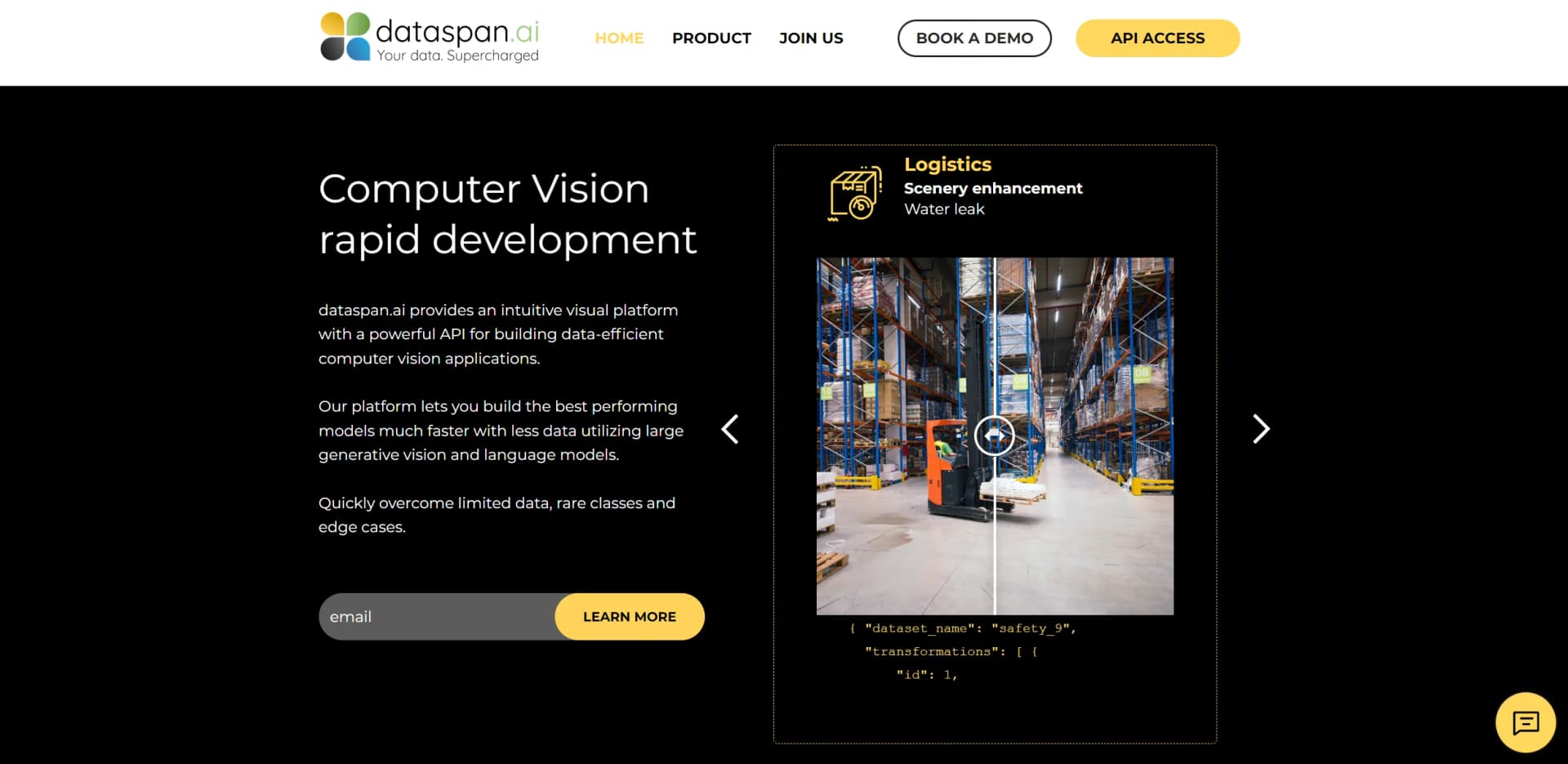
Exploring the realm of artificial intelligence, particularly in the area of computer vision, has never been more exciting or accessible thanks to innovative platforms like DataSpan. Positioned at the forefront of AI technology, DataSpan offers a robust generative AI platform that focuses on enhancing computer vision capabilities with minimal data. The platform is a game-changer for industries that rely heavily on visual data interpretation and manipulation, enabling users to build high-performance models efficiently and effectively.
DataSpan stands out by providing a powerful platform that significantly reduces the dependency on large datasets typically required for training effective computer vision models. Its ability to generate data and enhance models through generative AI and minimal input sets it apart in the tech industry.
DataSpan excels in providing advanced, efficient solutions for computer vision, making it an essential tool for businesses and professionals looking to leverage AI with minimal data. Its unique approach to model training and enhancement offers significant advantages in terms of time and cost savings, setting it apart as a leader in the AI technology space.
Who is Using DataSpan?
Manufacturing
Employed to enhance quality control with precise visual inspections.
Healthcare
Utilized in medical imaging to improve diagnostic accuracy.
Agriculture
Assists in crop monitoring through detailed aerial imagery analysis.
Retail
Enhances customer experiences by optimizing visual merchandising.
Uncommon Use Cases
Used by sports organizations to analyze game footage; adopted by media houses for automated video editing.
DataSpan is widely adopted across various sectors, demonstrating its versatility and effectiveness in addressing unique industry challenges.
Key Features
Rating Breakdown
Pricing Plans
Free Trial
- Get started with DataSpan with a risk-free proof of concept (PoC)
Subscription Plans
- Details on specific pricing plans are available upon request
DataSpan Use Cases
Defect detection
Detect surface imperfections and rare production-line-specific defects across manufactured components.
Outcome: Higher inspection accuracy and fewer missed defects.
Quality control
Enhance training sets for dimensional accuracy and consistency checks.
Outcome: More robust visual-inspection models.
Predictive maintenance
Monitor equipment for fatigue, wear, and other early signs of failure.
Outcome: Reduced unplanned downtime.
Changeover validation
Visually validate setup parameters before production begins.
Outcome: Less startup waste and fewer restarts.
Production-line monitoring
Use Visual Agents to monitor machines, processes, and operators continuously.
Outcome: Earlier alerts and improved OEE.
Workflow Ideas with DataSpan
Generate synthetic defect data
- 1Connect existing visual-inspection datasets
- 2Generate synthetic defect images from existing data and user inputs
- 3Use the generated data to train and validate visual-inspection models
Refine a visual-inspection dataset
- 1Review generated defect examples
- 2Describe desired changes using plain language and LLM feedback
- 3Iterate until the data reflects relevant production conditions
Monitor a production line
- 1Define what to monitor in plain language
- 2Create a Visual Agent and backfill historical data
- 3Monitor alerts, operator guidance, downtime, and throughput
How DataSpan fits into your stack
Cloud APIs
Easily integrate with existing data management and computer vision tools.
Python SDK
Utilize the provided SDK for enhanced functionality and integration.
Cross-Industry Applications
Offers solutions tailored to a wide range of industries from healthcare to sports.
Pros
- +Enhanced Efficiency: Drastically reduces the time required to collect, label, and train data.
- +Cost Reduction: Minimizes expenses associated with data collection and labeling.
- +Flexibility: Supports a wide range of industries with tailored computer vision solutions.
- +User-Friendly Interface: Provides an intuitive visual platform that simplifies complex processes.
Cons
- −Learning Curve: New users may require time to fully grasp the extensive features and capabilities.
- −Niche Specialization: Primarily focused on computer vision, which might not cater to all AI application needs.
- −Dependency on API: Heavy reliance on API integration might be a barrier for users with limited technical expertise.
Limitations & when to consider alternatives
Known limitations
- Requires an image source. Users need existing cameras or another source of images before the platform can generate or analyze visual data.
- Focused on industrial visual inspection. The platform is purpose-built for manufacturing and industrial visual-inspection models rather than general-purpose image or text tasks.
- Existing images are not modified. The service augments datasets with new generated data but does not alter the original images.
- Model training remains part of the customer workflow. Users use their current workflows to train and validate models based on the newly generated data.
How to Use DataSpan
- 1
Explore a variety of tutorials and resources provided by DataSpan to get the most out of their platform, from basic setup to advanced model training.
Who is DataSpan For?
Computer vision engineers
They can generate and refine industrial visual-inspection data for model development.
Data scientists
They can improve training datasets and validate visual-inspection models.
Subject matter experts
Shopfloor experts can guide generation and define what production-line agents should monitor.
Operations and maintenance leaders
They can use early anomaly detection and actionable alerts to reduce downtime.
Quality assurance leaders
They can detect more defects, reduce false rejects, and expand inspection coverage.
Frequently Asked Questions
Who is the main user of dataspan.ai?
Computer vision engineers, data scientists, and subject matter experts guide the generation process.
Does dataspan.ai modify existing datasets?
It augments datasets with newly generated data but does not modify existing images.
How many images are required for one use case?
The platform can generate a use case from as few as five images, and the company has worked with even fewer.
How quickly can the first batch of data be produced?
The company says the first batch can be available within a day or two.
Does dataspan.ai require new camera equipment?
No specific equipment is required; users can use existing cameras or install new ones as needed.
Is manual annotation required after generation?
No. Generated images include segmentation masks, so manual annotation is not required.
Community reviews
Be the first to share your experience.
Sign in to leave a review for DataSpan.
DataSpan Alternatives
Looking for alternatives to DataSpan? Here are similar tools in the same category:
Learn to Master DataSpan
With Skill Leap courses
Get in-depth training on DataSpan and 50+ other AI tools with our expert-led video courses.
Start 7-Day Free Trial