
Credo
Streamline AI governance with compliance, ethical standards, and risk management.
Key Takeaways
- What it is
- Streamline AI governance with compliance, ethical standards, and risk management.
- Best for
- AI Governance Platform
- Generative AI Guardrails
- AI Auditing
- Rating
- 4.4/5
What is Credo?
Credo AI is a pioneering tool in AI governance, designed to help organizations adopt, scale, and manage their AI solutions responsibly. It provides robust frameworks to ensure compliance with regulations, maintain ethical AI practices, and manage the lifecycle of AI systems effectively. This tool is essential for businesses integrating AI into their operations while upholding safety, ethics, and regulatory standards.
Credo AI stands out with its comprehensive approach to AI governance, focusing on compliance, ethical implications, and societal impact. Its ability to provide tailored solutions across various regulations and standards distinguishes it in the market.
Credo AI excels in providing a comprehensive framework for AI governance, making it essential for organizations implementing AI responsibly. With its robust compliance and risk management features, extensive support, and educational resources, Credo AI offers significant advantages in the responsible deployment of AI technologies.
Who is Using Credo?
Large Enterprises
Implementing comprehensive AI governance across departments.
Healthcare Organizations
Ensuring compliance and ethical use of AI tools in diagnostics and patient management.
Financial Institutions
Managing risk and compliance for AI-driven financial products.
Educational Institutions
Using AI governance knowledge for curricula development and research.
Uncommon Use Cases
Non-profits using AI for ethical fundraising; small businesses using AI for customer service enhancements.
Key Features
Rating Breakdown
Pricing Plans
Free Trial
- Limited-time free trial available to explore Credo AI's features
Subscription Model
- Tiered pricing based on features and support levels
- Tailored to organization sizes and needs
Credo Use Cases
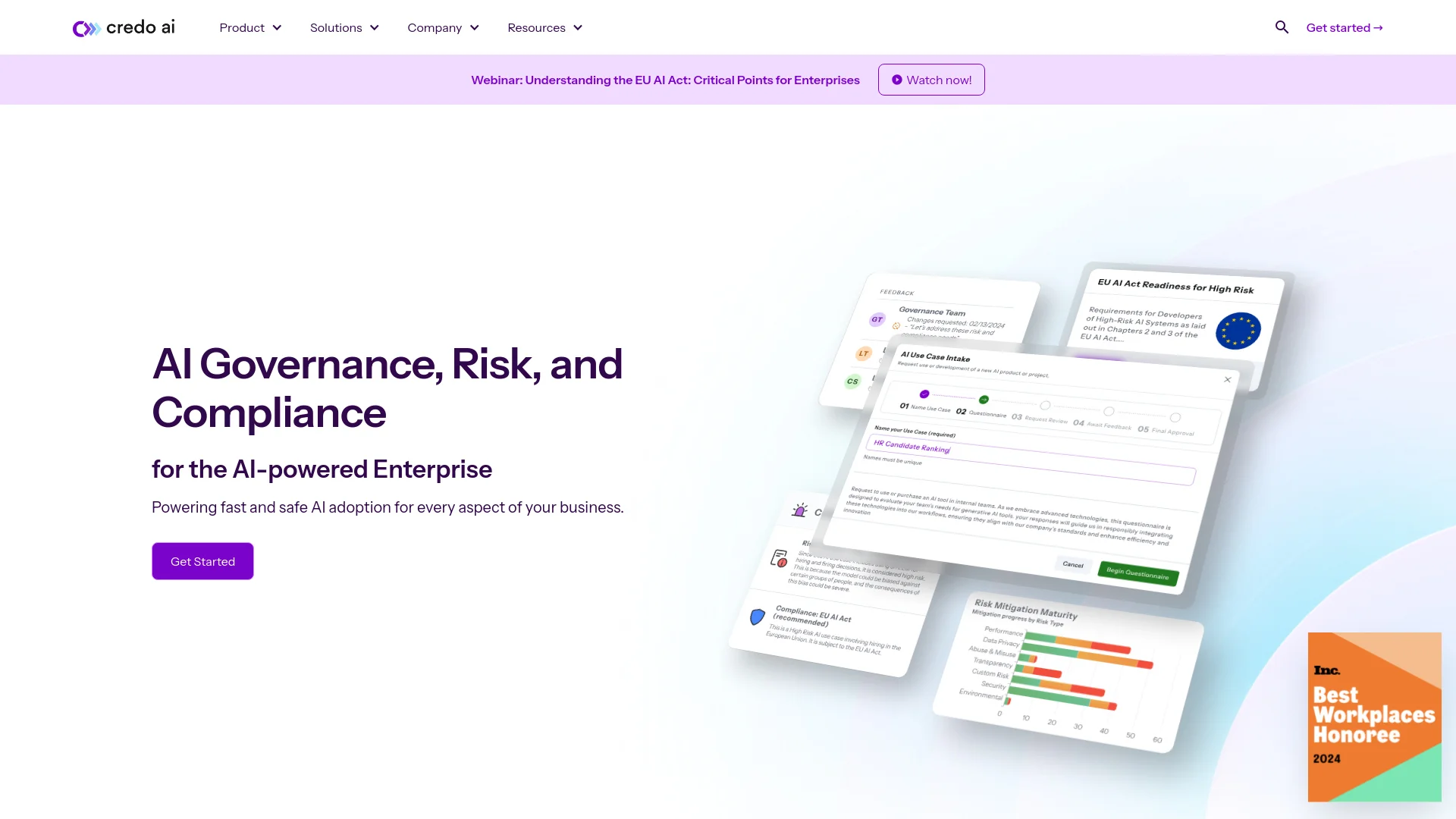
AI use-case intake
Teams submit AI applications for assessment and route them through governance workflows.
Outcome: Centralized visibility into AI adoption and risk.
Generative AI risk management
Organizations collect evidence, categorize generative AI use cases, and route them to appropriate oversight.
Outcome: Faster and more scalable review of generative AI initiatives.
Regulatory compliance
Governance teams map AI systems and evidence to regulatory requirements and standards.
Outcome: Audit-ready compliance artifacts and traceability.
Model and vendor governance
Organizations register models and third-party AI vendors, connect relationships, and monitor associated risk.
Outcome: Portfolio-level visibility into AI dependencies and risk.
Continuous AI oversight
Teams connect monitoring and observability data to revisit approved use cases and detect drift.
Outcome: Ongoing governance after deployment rather than one-time approval.
Workflow Ideas with Credo
ServiceNow AI intake to Credo AI governance
- 1Create an AI intake record in ServiceNow
- 2Trigger the Credo AI integration to create a corresponding use case
- 3Track governance status, evidence, and workflow progress in Credo AI
Model-store governance workflow
- 1Connect a model store such as MLflow, Databricks, or SageMaker
- 2Upload or register model metadata in Credo AI
- 3Apply policies, risk scenarios, and governance controls
Compliance evidence to audit artifact
- 1Collect evidence from connected systems
- 2Map evidence to regulatory or policy requirements
- 3Generate governance, risk, and compliance artifacts
How Credo fits into your stack
API Access
Integration with existing systems through robust APIs.
Cloud Compatibility
Compatible with major cloud platforms for easy deployment.
Third-Party Software
Supports integration with popular third-party software for enhanced functionality.
Continuous Updates
Regular updates to reflect the latest in AI governance and compliance standards.
Pros
- +Enhanced Compliance: Helps meet stringent regulatory standards, reducing legal risks.
- +Risk Management: Evaluates AI systems for operational, regulatory, and reputational risks.
- +Educational Resources: Provides extensive training and resources for effective AI governance.
- +Customizable Solutions: Adapts to different organizational needs for tailored AI governance strategies.
Cons
- −Complexity in Implementation: May involve a steep learning curve for those new to AI governance.
- −Resource Intensive: Requires significant time and manpower, especially in large-scale environments.
- −Cost Considerations: The cost might be a barrier for smaller organizations or startups.
Limitations & when to consider alternatives
Known limitations
- Enterprise-oriented purchasing. The terms describe fees through order forms or statements of work rather than publishing standard self-service pricing.
- Self-hosted infrastructure requirements. Self-hosted deployments require infrastructure such as Kubernetes or VMs, PostgreSQL, S3-compatible object storage, SMTP, DNS, TLS, and an identity provider.
- SSO dependency for self-hosted deployments. Local user authentication is not available for self-hosted instances; an OIDC identity provider and OAuth2 authorization server are required.
- SAML requires an adapter. OIDC is supported natively, while SAML integration requires an adapter such as the included Dex identity-provider component.
- API documentation access. The API guide states that public endpoint documentation is accessible to customers.
Look elsewhere when
- You need a consumer-facing mobile AI app.
- You need a dedicated desktop application.
- You need AI model fine-tuning or training jobs.
- You need image analysis or code generation as the core product experience.
How to Use Credo
- 1
Access tutorials and webinars on the Credo AI website, covering everything from basic setup to advanced governance techniques.
Who is Credo For?
AI governance teams
They can inventory AI systems, classify risk, apply policies, manage workflows, and maintain oversight.
Legal, risk, compliance, and security teams
The platform centralizes evidence, regulatory mappings, reviews, approvals, and audit-ready artifacts.
Engineering and data science teams
They can connect model stores and development systems to automate governance data collection.
Business and AI use-case owners
They can submit use cases, provide evidence, respond to assessments, and track governance status.
Enterprise organizations
Credo AI is positioned for organizations governing AI across departments, jurisdictions, models, applications, and vendors.
Frequently Asked Questions
What does Credo AI govern?
Credo AI governs agents, applications, models, vendors, and AI workflows across their lifecycle.
How does Credo AI support compliance?
It provides policy packs, compliance mapping, evidence recording, audit trails, and governance artifacts for frameworks such as the EU AI Act, NIST AI RMF, and ISO 42001.
Can Credo AI integrate with existing enterprise systems?
Yes. The platform lists integrations with systems including Snowflake, Databricks, AWS, Azure, ServiceNow, Jira, Confluence, Slack, GitHub, and MLflow.
Does Credo AI offer an API?
Yes. Credo AI provides REST and JSON API access, API keys, OpenAPI documentation, and official Python and TypeScript SDKs.
Can Credo AI be self-hosted?
Yes. Credo AI documents deployment in private cloud environments, Kubernetes clusters, or virtual machines.
Does Credo AI support single sign-on?
Self-hosted deployments require an OIDC identity provider and OAuth2 authorization server; SAML can be connected through an adapter.
Community reviews
Be the first to share your experience.
Sign in to leave a review for Credo.
Credo Alternatives
Looking for alternatives to Credo? Here are similar tools in the same category:
Learn to Master Credo
With Skill Leap courses
Get in-depth training on Credo and 50+ other AI tools with our expert-led video courses.
Start 7-Day Free Trial