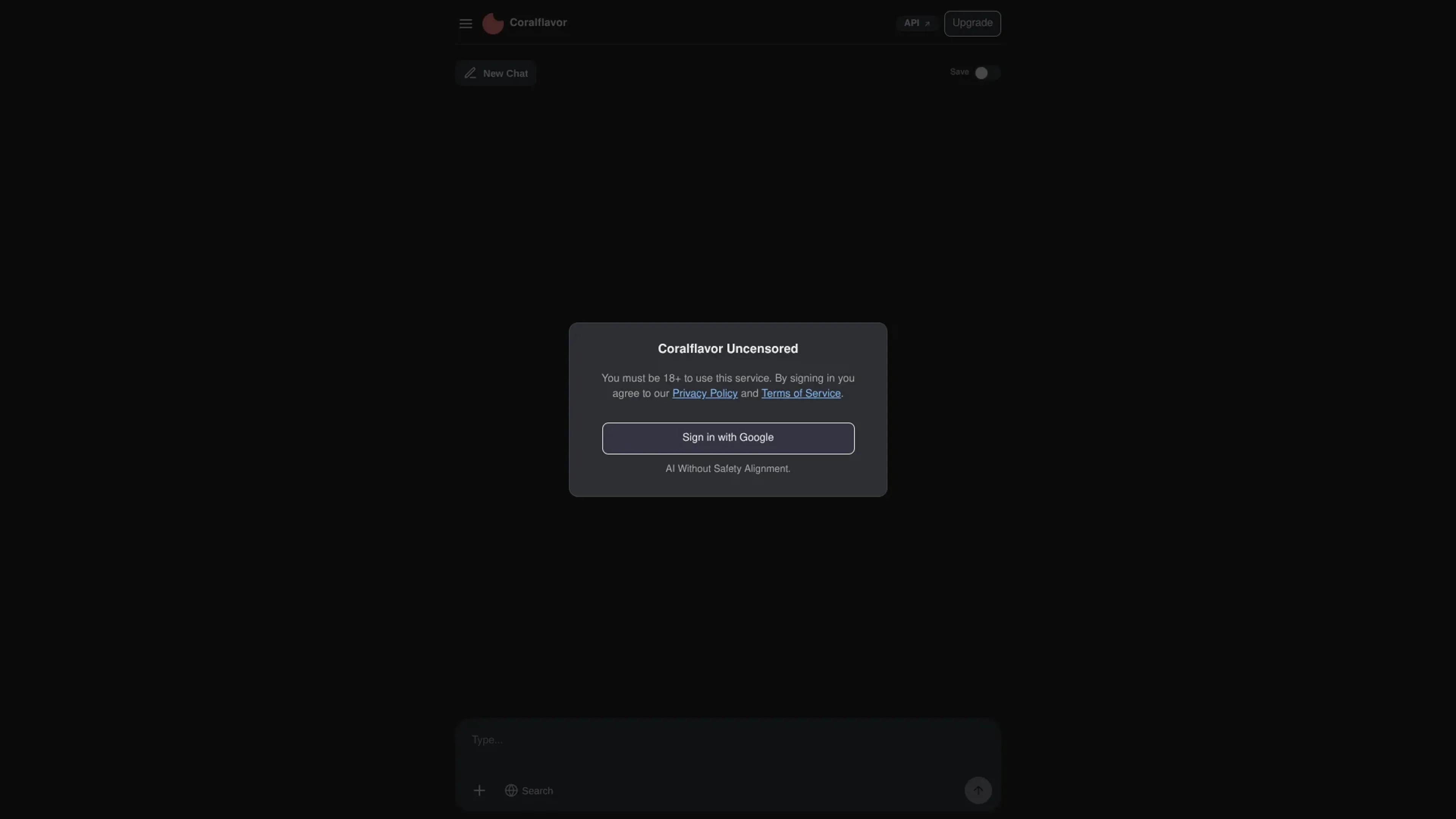
Coralflavor focuses on secure, uncensored AI chat for adults. It offers an AI model with no traditional safety alignment, so users can ask almost anything and receive direct answers in a private setting. The service targets people who feel mainstream chatbots are too restricted, and it extends beyond simple chat with an OpenAI‑compatible API, optional chat history controls, and a Pro tier that adds uncensored web search plus file uploads for text extraction.
Key Features:
Unfiltered adult AI chat: AI interactions without typical safety filters, explicitly restricted to users aged 18 and over.
Privacy controls with burn mode: Toggle between saving chats by default or “burn by default” so conversations are not stored.
Pro web search and grounding: Pro users can run uncensored web search and ground prompts on live online sources inside chat.
File upload for text extraction (Pro): Upload PDFs and images to extract text directly in conversations, useful for documents or screenshots.
OpenAI‑compatible uncensored API: Token‑billed API with streaming support, allowing developers to call the Coralflavor model using familiar OpenAI‑style interfaces.
Pros
Straightforward interface: Clean, minimal UI focused on the chat window and simple settings.
Serious privacy posture: Adult‑only positioning, burn mode, and no‑frills account system appeal to privacy‑minded users.
Developer friendly: OpenAI‑style API lowers integration friction for existing codebases and tools.
Good for “blocked elsewhere” topics: Handles many controversial or sensitive prompts that mainstream models typically refuse.
Cons
No safety alignment: Higher risk of harmful, offensive, or legally problematic outputs; users must self‑police.
Limited ecosystem and docs: Newer service with fewer tutorials, community resources, and integrations.
Compliance concerns for organizations: Lack of safety rails will be a non‑starter for most corporate or regulated environments.
Who is Using Coralflavor?
Adult creators and role‑players: Using the uncensored model for NSFW stories, characters, and fantasy scenarios.
Independent developers: Plugging the API into apps that need unfiltered model behavior or custom moderation rules.
Researchers and tinkerers: Testing how unaligned models respond to sensitive prompts for alignment and safety studies.
Writers and power users: Exploring taboo, controversial, or dark themes in fiction and brainstorming without content blocks.
Uncommon Use Cases: Used by moderation and trust‑and‑safety researchers to stress‑test filters and prompt attacks.
Uncommon Use Cases: Adopted by experimental artists building provocative chat installations where conventional AIs would refuse content.
Pricing:
Free Tier: $0 per month; includes access to basic features.
API Credits: Custom pricing; required for premium access and advanced model usage, purchased directly on the platform.
Disclaimer: Please note that pricing information may not be up to date. For the most accurate and current pricing details, refer to the official Coralflavor website.
What Makes Coralflavor Unique?
Coralflavor puts uncensored behavior and adult‑only access at the center of its design, instead of treating them as edge cases. The pairing of an OpenAI‑compatible, unaligned LLM with explicit privacy controls like burn mode gives power users and developers a rare mix: a model that is intentionally unfiltered, yet framed around security and anonymity rather than clickbait edginess.
How We Rated It:
Accuracy and Reliability: 3.9/5
Ease of Use: 4.3/5
Functionality and Features: 4.0/5
Performance and Speed: 4.1/5
Customization and Flexibility: 3.7/5
Data Privacy and Security: 3.8/5
Support and Resources: 3.2/5
Cost-Efficiency: 4.0/5
Integration Capabilities: 3.9/5
Overall Score: 3.9/5
Unfiltered Adult AI Chat With A Privacy‑First Attitude:
Coralflavor suits adults who are comfortable managing their own risk and want a frank, uncensored AI that does not constantly refuse prompts. The service trades corporate‑grade safety systems for user control, privacy features, and an API that drops easily into existing OpenAI‑style code. For enterprises and sensitive domains that require strict guardrails, it will feel too raw. For privacy‑conscious power users and experimental developers, it can be a very compelling niche tool.