
Composable Prompts
Unleash LLM power: automate, integrate, optimize enterprise processes.
Key Takeaways
- What it is
- Unleash LLM power: automate, integrate, optimize enterprise processes.
- Best for
- API-First Design
- Advanced Security Features
- Flexible Model Testing and Deployment
- Rating
- 4.3/5
What is Composable Prompts?
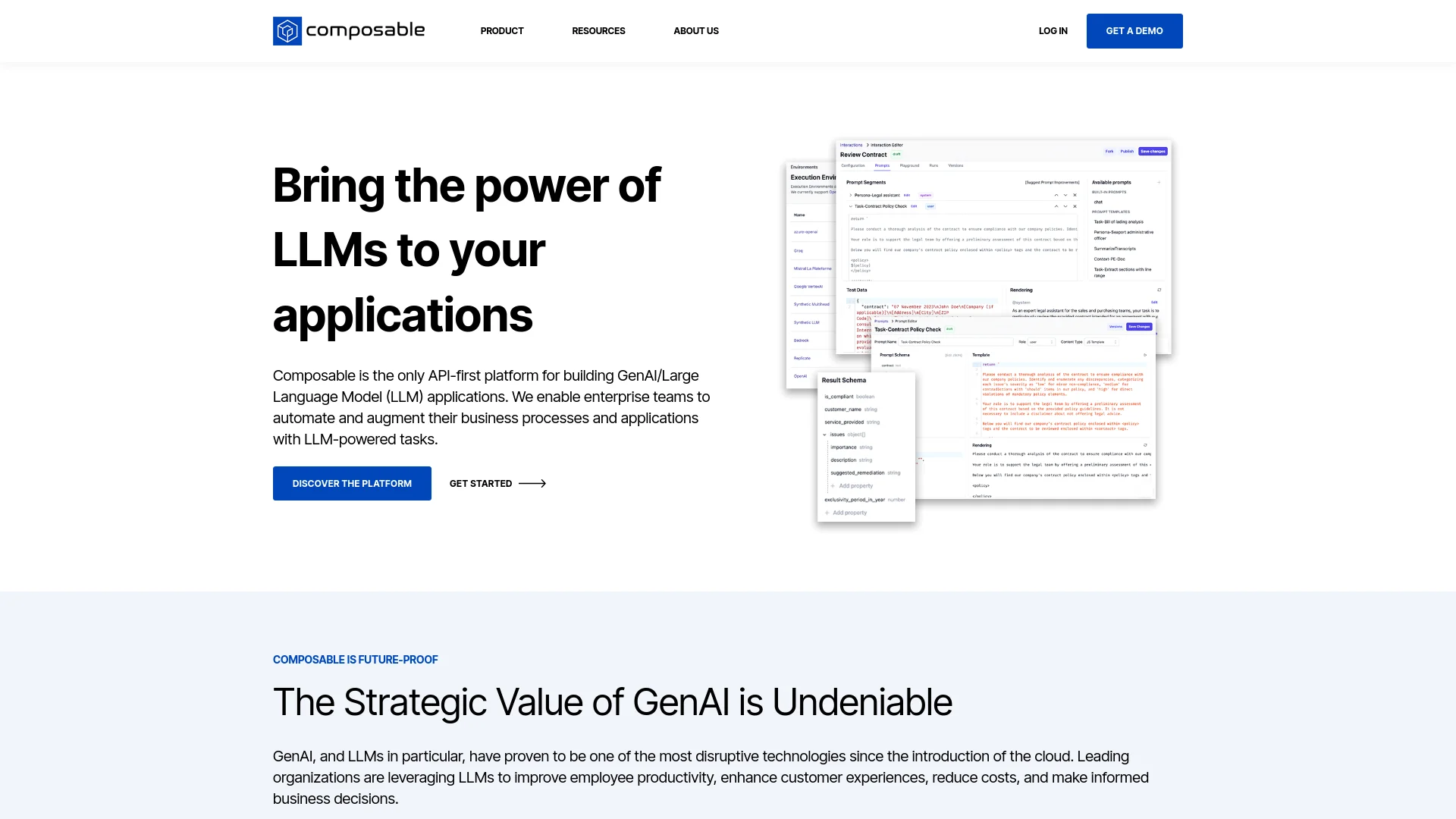
Composable Prompts is a cutting-edge platform specifically designed for building applications powered by Large Language Models (LLMs). As an API-first platform, it focuses on helping enterprise teams automate and augment their business processes. The tool provides a robust environment to design, test, deploy, and operate LLM-powered tasks, ensuring efficiency, enhanced performance, and cost reduction in various business applications.
Composable Prompts stands out with its robust API-first approach, allowing for seamless integration and management of LLM tasks within enterprise environments. Its unique selling point lies in its comprehensive security and governance features, ensuring that enterprises can deploy LLM technology confidently and securely.
Composable Prompts excels in providing robust, secure, and efficient LLM-powered automation capabilities, making it an essential tool for enterprises looking to enhance their applications. Its standout security features and flexible API-first design offer significant advantages, positioning it as a leader in the LLM application development space.
Who is Using Composable Prompts?
Tech Enterprises
Utilizing the platform to enhance their software solutions with LLM capabilities.
Financial Institutions
Automating document processing and compliance checks.
Healthcare Organizations
Improving patient data management and treatment planning.
Educational Institutions
Developing advanced educational tools and content customization.
Uncommon Use Cases
Non-profits using it for grant writing and reporting; startups for rapid prototyping of AI features.
Key Features
Rating Breakdown
Pricing Plans
Enterprise Custom Solutions
- Tailored pricing based on the enterprise needs and scale
Which Composable Prompts plan should you pick?
Start with Pro for a small team; upgrade to Expert for fine-tuning and expanded support, or Enterprise for multiple teams, custom SSO, and dedicated deployment options.
Pro
Good for small teams who need core AI application and agent-building capabilities with standard support and SSO.
Expert
Good for medium to large teams who need fine-tuning, shared customer success, and email, chat, and phone support.
Enterprise
Good for multiple teams or enterprise-wide AI programs that need custom SSO, dedicated customer success, and optional self-managed or dedicated SaaS deployment.
Composable Prompts Use Cases
Create summaries
Summarize documents and other business content with reusable AI tasks.
Outcome: Faster access to key information.
Co-pilot assistance
Assist employees while they complete business tasks using governed enterprise context.
Outcome: More efficient human decision-making.
Repurpose content
Generate tests, training materials, custom calls to action, and draft copy from existing content.
Outcome: More content variations with less manual effort.
Contract analysis
Ingest contracts, extract key terms, summarize clauses, and identify compliance risks.
Outcome: Faster contract review and risk assessment.
Knowledge retrieval
Search across enterprise content sources and return permission-aware answers with sources.
Outcome: More accurate business-specific answers.
Workflow Ideas with Composable Prompts
Automated contract review
- 1Integrate contract-management content and ingest documents
- 2Extract parties, terms, and clauses with LLM tasks
- 3Summarize findings and produce compliance recommendations
Enterprise knowledge workflow
- 1Connect sources such as Google Workspace, SharePoint, Confluence, Notion, or Box
- 2Prepare and structure documents for AI retrieval
- 3Answer questions with permission-aware semantic search and sources
Fine-tuning from production runs
- 1Capture interaction inputs and results in the executions store
- 2Create a training dataset from selected runs
- 3Enable a fine-tuned model and deploy it through the platform
How Composable Prompts fits into your stack
Multiple LLM Providers
Supports various LLM providers, ensuring flexibility in choosing the right model for specific tasks.
Extensive API Integrations
Easily integrates with existing enterprise systems via its comprehensive API.
Security and Compliance Tools
Integrates with leading security and compliance frameworks to ensure enterprise-grade data protection.
Development Environments
Compatible with major development environments, facilitating easy adoption and integration.
Pros
- +Efficiency in Automation: Streamlines business processes by automating tasks with LLM technology.
- +Cost Reduction: Reduces operational costs through optimized performance and intelligent resource management.
- +Scalability: Easily scales across enterprise applications due to its API-first approach and robust infrastructure.
- +Enhanced Security: Minimizes potential security risks with advanced security measures and governance protocols.
Cons
- −Complexity in Initial Setup: Requires a certain level of technical expertise to integrate and manage effectively.
- −Dependence on External Models: Relies on third-party LLMs, which might affect performance based on their availability and updates.
- −Higher Learning Curve: New users may require additional time to familiarize themselves with the platform’s capabilities and features.
Limitations & when to consider alternatives
Known limitations
- No public self-serve pricing. The pricing page lists annual Pro, Expert, and Enterprise subscriptions but requires a pricing request.
- Fine-tuning is plan-limited. Fine-tuning is listed for Expert and Enterprise, not the Pro plan.
- Enterprise-oriented product. The platform is positioned for departmental, multi-team, and enterprise-wide AI programs rather than an individual consumer workflow.
Look elsewhere when
- You need a native mobile app.
- You need a dedicated browser extension.
- You need a coding-focused AI generator.
How to Use Composable Prompts
- 1
Choose a project and use case
Start with a business workflow such as document summarization, knowledge retrieval, contract review, or content repurposing.
- 2
Compose prompts and schemas
Create reusable prompt segments with typed parameters, including text, document, and media inputs.
- 3
Test across models
Run interactions against supported models and environments to compare quality, validate schemas, and refine prompts.
- 4
Add enterprise content
Connect business sources and prepare documents, images, and other content for governed retrieval and AI processing.
- 5
Expose the workflow
Publish the task, workflow, or agent through its REST API endpoint, OpenAPI specification, JavaScript SDK, or CLI.
- 6
Monitor and improve
Review execution history, analytics, and outputs; use selected runs for training datasets and fine-tuning when available on your plan.
Who is Composable Prompts For?
Marketing teams
Use AI for content repurposing, personalized content, summaries, and custom calls to action.
Product development and engineering
Build and integrate LLM-powered tasks and applications using APIs, SDKs, prompts, and schemas.
Customer service and support
Automate ticket categorization, research, summarization, and customer-facing assistance.
Finance and risk management
Apply AI to document review, risk analysis, compliance, and operational decision support.
Legal and compliance teams
Analyze contracts, identify risks, standardize processes, and automate compliance checks.
Frequently Asked Questions
What is Vertesia?
Vertesia is the renamed successor to Composable Prompts, evolving from prompt-engineering infrastructure into a broader enterprise AI platform.
What can Vertesia build?
Teams can design, test, deploy, and operate generative AI applications, tasks, and autonomous agents.
Does Vertesia provide APIs?
Yes. Tasks, workflows, and agents expose REST API endpoints, with OpenAPI/Swagger and JavaScript SDK support.
Does Vertesia support multiple AI models?
Yes. The platform supports multiple models and providers so teams can switch models without rewiring applications.
Does Vertesia support enterprise security?
Yes. It supports SSO, AES-256 and TLS encryption, access controls, auditability, and enterprise compliance requirements.
Does Vertesia offer fine-tuning?
Fine-tuning is supported on the Expert and Enterprise plans, including training-dataset creation from runs.
Community reviews
Be the first to share your experience.
Sign in to leave a review for Composable Prompts.
Composable Prompts Alternatives
Looking for alternatives to Composable Prompts? Here are similar tools in the same category:
Learn to Master Composable Prompts
With Skill Leap courses
Get in-depth training on Composable Prompts and 50+ other AI tools with our expert-led video courses.
Start 7-Day Free Trial