Climate Policy Radar
AI-driven analysis of global climate policies and laws.
Key Takeaways
- What it is
- AI-driven analysis of global climate policies and laws.
- Best for
- Comprehensive Database
- Advanced Search Capabilities
- Comparative Analysis
- Rating
- 4.7/5
What is Climate Policy Radar?
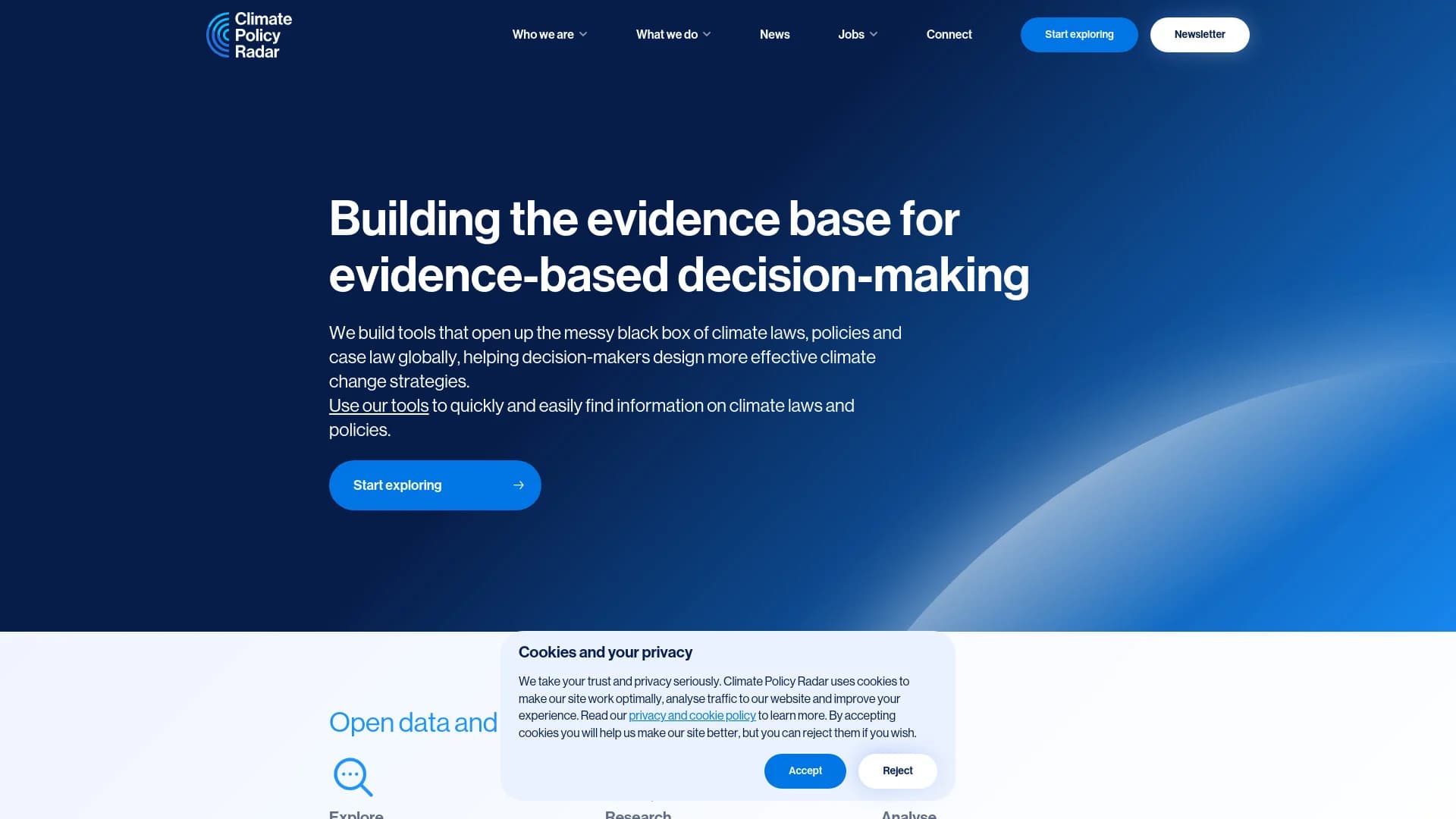
Climate Policy Radar is an innovative AI tool designed to streamline the complex world of climate law and policy research. By leveraging advanced data science and artificial intelligence, this platform transforms the vast and scattered documents of climate policies and laws into searchable, accessible, and analyzable information. It is tailored for policymakers, researchers, and advocates dedicated to designing effective climate change strategies and ensuring informed decision-making.
Climate Policy Radar stands out by converting the intricate and dispersed information of global climate policies into streamlined, actionable insights. Its unique integration of AI for document analysis and trend detection makes it a critical tool for anyone involved in climate advocacy, policy-making, or research.
Climate Policy Radar excels in transforming the complex landscape of global climate policies into a navigable, insightful tool that is indispensable for informed policymaking. Its robust AI-driven search and analysis capabilities, coupled with its commitment to open data, make it a pioneering resource in climate policy research. Whether you're a policymaker, researcher, or advocate, Climate Policy Radar offers a unique set of tools to enhance your understanding and effectiveness in climate action.
Who is Using Climate Policy Radar?
Government Agencies
Employing the tool to craft and revise national climate policies.
Academic Researchers
Utilizing the platform for scholarly articles and advanced climate research.
Environmental NGOs
Leveraging the tool to advocate for stronger climate action and accountability.
Legal Professionals
Using the tool to understand and interpret climate-related legislation.
Uncommon Use Cases
Utilized by financial analysts to assess environmental risk in investments; adopted by educators to teach climate policy courses.
Key Features
Rating Breakdown
Pricing Plans
Free Access
- Climate Policy Radar offers open access to its tools and data
- Promoting transparency and universal usability
Climate Policy Radar Use Cases
Search national climate laws and policies
Search full text across national climate laws, policies, strategies, and action plans.
Outcome: Faster discovery of relevant policy evidence.
Track international climate commitments
Explore NDCs, BTRs, UN submissions, and other international climate documents.
Outcome: Compare national commitments and identify gaps.
Analyse climate litigation
Search and analyse court cases shaping climate accountability worldwide.
Outcome: Better understanding of legal arguments, decisions, and actors.
Explore climate finance
Search projects and funding documents from major multilateral climate funds.
Outcome: Improved access to climate-finance information.
Integrate climate evidence into other systems
Connect Climate Policy Radar data to external systems using API and MCP.
Outcome: Use the dataset in research, workflows, or products.
Workflow Ideas with Climate Policy Radar
Find policy evidence
- 1Search laws, policies, litigation, finance documents, or UN submissions.
- 2Use smart search and topic filters to narrow relevant passages.
- 3Compare and trace evidence across documents.
Investigate a country
- 1Open a country profile.
- 2Review recent documents and climate-policy information.
- 3Follow linked documents and source material for deeper research.
Build with the data
- 1Identify the dataset or interface relevant to your project.
- 2Request early access to API or MCP connectivity.
- 3Bring the structured evidence into your own system or product.
How Climate Policy Radar fits into your stack
API Access
Developers can integrate Climate Policy Radar's functionalities into other applications.
Cross-Platform Compatibility
Accessible via web on multiple devices, enhancing flexibility for users.
Data Integration
Supports importing data from various external sources to enrich analysis.
Collaboration Features
Enables sharing of insights and data among team members or across organizations.
Pros
- +Efficiency in Research: Significantly reduces the time required to find and analyze relevant policy documents.
- +Depth of Insight: Offers deep analytical capabilities to understand the effectiveness of various climate laws and policies.
- +User-Friendly Interface: Designed with a straightforward layout to facilitate ease of use for all users.
- +Supports Informed Policymaking: Helps in tracking progress and modeling policy risks, crucial for meeting international climate goals.
Cons
- −Complexity of Information: New users may initially struggle with the depth and breadth of information available.
- −Language Limitations: While it aggregates global data, language barriers in non-English documents could pose challenges.
- −Dependency on Data Quality: The effectiveness of the tool is contingent on the quality and completeness of the input data.
Limitations & when to consider alternatives
Known limitations
- Automatic translations may be imperfect. The application states that English translations provided by Google Cloud Translate may not be 100% accurate.
- Topic classification is not fully accurate. The application warns that topic identification and highlighting accuracy is not 100%.
- API and MCP access requires early access. The organisation directs prospective users to contact it for early access to API and MCP connectivity.
Look elsewhere when
- You need a native mobile application.
- You need custom third-party integrations.
- You need user-uploaded documents analyzed by the product.
How to Use Climate Policy Radar
- 1
Explore a range of tutorials on the Climate Policy Radar website, designed to help users from basic navigation to advanced features of the tool.
Who is Climate Policy Radar For?
Policymakers
They can search global climate laws, policies, targets, and government action to support evidence-based decision-making.
Researchers
They can search, compare, and trace evidence across tens of thousands of climate and nature documents.
International institutions
They can use structured global evidence covering laws, policies, finance, litigation, and international submissions.
Legal and finance practitioners
They can investigate climate-related legal developments, policies, disclosures, and finance documents.
Civil society organisations
They can access open evidence to track commitments, identify gaps, and support accountability.
Frequently Asked Questions
What is Climate Policy Radar?
Climate Policy Radar builds infrastructure that turns fragmented climate and nature data into structured, searchable evidence.
What can users search?
Users can search laws, policies, litigation records, finance documents, UN submissions, corporate disclosures, and other climate-related documents.
Does Climate Policy Radar use AI?
Its AI tools organise data and map concepts across documents. The organisation says tools are expert-defined, built, and validated.
Are documents translated?
Documents are automatically translated into English, although the site warns that translations may not be 100% accurate.
Can organisations access the data programmatically?
Climate Policy Radar offers API and MCP connectivity for direct integration, with early access available through the organisation.
Is the data open?
The organisation states that its data, tools, and systems are freely accessible, and its data is available under open licensing terms.
Community reviews
Be the first to share your experience.
Sign in to leave a review for Climate Policy Radar.
Climate Policy Radar Alternatives
Looking for alternatives to Climate Policy Radar? Here are similar tools in the same category: