Cebra
Revolutionizes time series analysis, decoding complex neural and behavioral data.
Key Takeaways
- What it is
- Revolutionizes time series analysis, decoding complex neural and behavioral data.
- Best for
- Advanced Latent Embeddings
- Behavioral and Neural Data Analysis
- High-Performance Decoding
- Rating
- 4.4/5
What is Cebra?
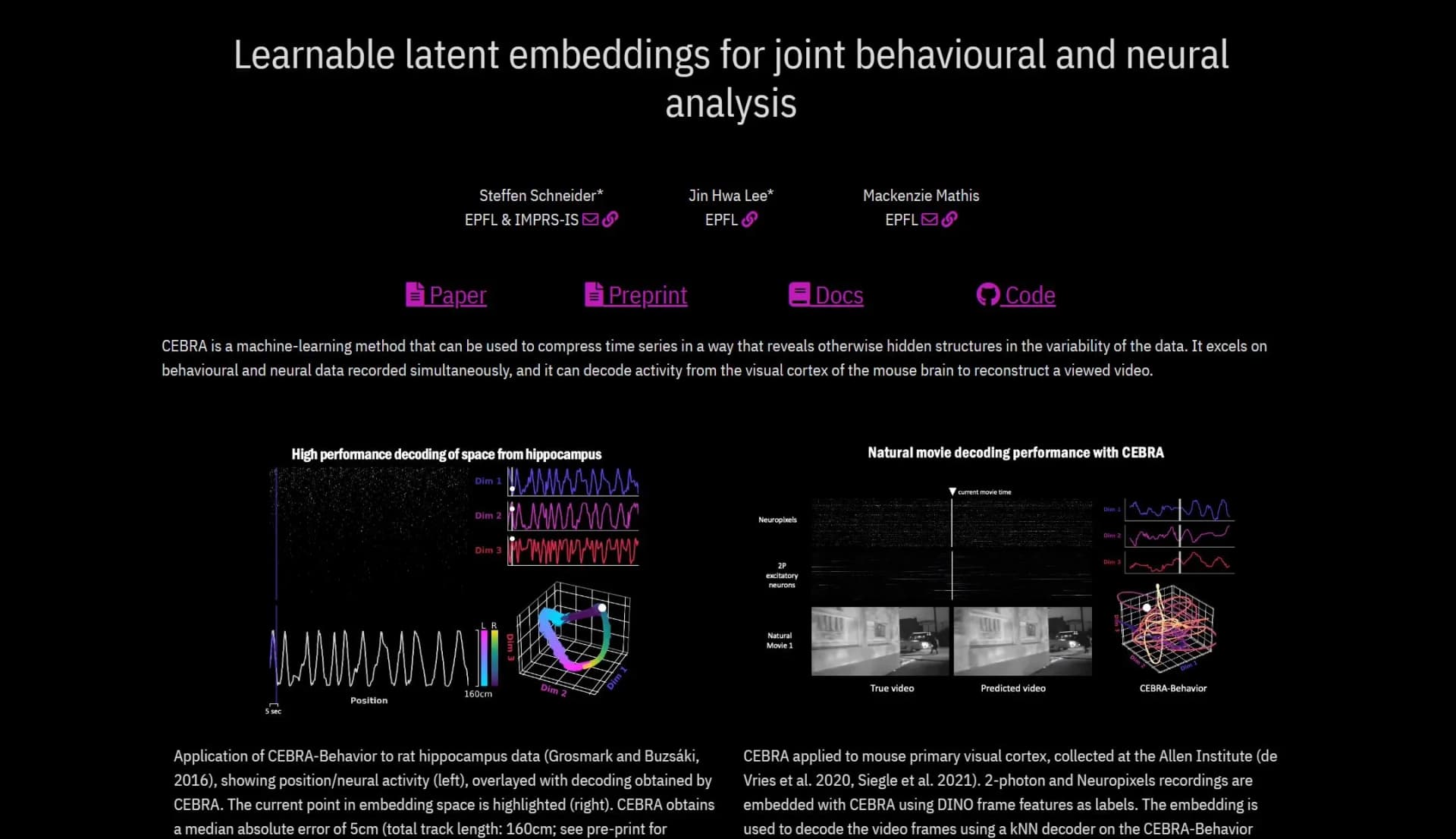
Cebra is an advanced artificial intelligence tool designed to revolutionize the analysis and interpretation of complex time series data. Focused on uncovering hidden structures within data variability, Cebra shines for its capability to handle both behavioral and neural data simultaneously. It's not just a tool; it's a breakthrough method capable of decoding activity from a mouse's visual cortex to reconstruct viewed video, showcasing its power in bridging the gap between observed behavior and neural activity.
Cebra stands out for its pioneering approach to combining behavioral and neural data analysis through learnable latent embeddings. Its capability to analyze and decode neural activities into comprehensible outputs sets it apart in neuroscience and beyond. This tool isn't just an analytical platform; it's a bridge between raw neural data complexities and tangible realities they represent.
Cebra is a trailblazer in neural and behavioral data analysis, offering unparalleled insights through advanced latent embeddings. Its ability to decode complex neural data makes it essential for researchers and professionals across disciplines. Despite its learning curve, Cebra's open-source nature and cost-efficiency make it valuable for advancing our understanding of behavior and neural activity.
Who is Using Cebra?
Neuroscientists
Mapping neural activities to behaviors, enhancing understanding of brain function.
Behavioral Researchers
Analyzing complex behavioral data alongside neural signals.
Healthcare Data Scientists
Utilizing Cebra for advanced analysis of medical time series data, like monitoring patient behaviors and corresponding neural activities.
Educational Institutions
Adopting Cebra as a teaching tool in advanced courses on machine learning, neuroscience, and data analysis.
Uncommon Use Cases
Filmmakers exploring the neural basis of visual perception; Video game developers creating immersive experiences based on neural and behavioral feedback.
Key Features
Rating Breakdown
Pricing Plans
Free Algorithm Access
- Core Cebra algorithm available for free on GitHub
- Promoting open-source collaboration and innovation
Custom Implementation Consultation
- Tailored applications or extensive support
- Users may contact the Cebra team directly
Cebra Use Cases
Neural and behavioral embedding
Jointly model neural recordings and behavioral variables to produce low-dimensional latent spaces.
Outcome: Consistent representations of neural and behavioral dynamics.
Unsupervised time-series exploration
Use CEBRA-Time to explore structure in time-series data without behavioral labels.
Outcome: Discovery of latent structure in recorded data.
Hypothesis-guided decoding
Use CEBRA-Behavior with candidate labels and compare the resulting embeddings and losses.
Outcome: Evidence about which labels contribute to observed structure.
Neural decoding
Train embeddings and downstream decoders to decode position, movement, or visual features.
Outcome: Decoded behavioral or sensory variables from neural activity.
DeepLabCut behavioral clustering
Load DeepLabCut output files and train embeddings on keypoint trajectories.
Outcome: Two-dimensional or three-dimensional behavioral embeddings.
Workflow Ideas with Cebra
Explore and test latent structure
- 1Run CEBRA-Time for unsupervised data exploration
- 2Sweep model hyperparameters and inspect the embedding
- 3Use CEBRA-Behavior with candidate labels and compare fit
Train and evaluate a custom embedding
- 1Load neural and auxiliary data from supported files
- 2Fit a CEBRA model and create embeddings
- 3Evaluate consistency, decoding performance, and visualization
Analyze DeepLabCut behavior
- 1Load DeepLabCut HDF5 output with the built-in loader
- 2Train a CEBRA-Time model on keypoint data
- 3Visualize the resulting behavioral embedding
How Cebra fits into your stack
GitHub Repository
Easy access to Cebra's official implementation for developers and researchers.
Multi-Dataset Support
Compatible with various data types, including 2-photon and Neuropixels recordings.
Community Support
Via GitHub and the official mailing list, users can stay updated and get support from the Cebra community.
Educational Resources
Preprint documentation and potential tutorials available for learning how to maximize Cebra's capabilities.
Pros
- +Unmatched Data Compression: Efficiently compresses time series data while retaining critical information, enabling deeper insights.
- +Holistic Data Analysis: Integrates behavioral and neural data for a comprehensive analysis, enhancing understanding of neural dynamics during adaptive behaviors.
- +High Accuracy Decoding: Demonstrates high accuracy in decoding tasks, such as reconstructing visual experiences from neural data.
- +Cross-Species Utility: Effective across different species and data types, including calcium and electrophysiology datasets.
Cons
- −Specialized Knowledge Requirement: Users may need a solid background in neuroscience or related fields to fully leverage Cebra's capabilities.
- −Complex Setup for Novices: Setting up and optimizing Cebra for specific research needs could be challenging for those new to machine learning or neural data analysis.
- −Limited to Time Series Data: Primarily designed for time series analysis, which might limit applicability outside behavioral and neural research contexts.
Limitations & when to consider alternatives
Known limitations
- Active development. The documentation warns that the API may include breaking changes between versions.
- GPU recommended for performance. CPU-only execution is supported, but CEBRA is most effective with a GPU.
- Limited full-dataset mode. Using the full dataset with batch_size=None is implemented only for single-session training with continuous auxiliary variables.
- Labels can cause embedding collapse. Using CEBRA-Behavior with labels not encoded in the data can produce a collapsed, non-converged embedding.
- Input preprocessing is external. The data loader reads data but does not perform preprocessing; data must already be ready for CEBRA.
Look elsewhere when
- You need a native mobile application.
- You need a browser extension or hosted browser workspace.
- Your primary need is image-understanding rather than time-series embeddings.
How to Use Cebra
- 1
Explore the GitHub repository for official documentation and guides on setting up and using Cebra for research needs. While direct tutorials may not be listed, comprehensive documentation and active community support provide a solid foundation for new users.
Who is Cebra For?
Machine-learning researchers
CEBRA provides scikit-learn-style and PyTorch APIs for building and analyzing learned embeddings.
Neuroscience researchers
The tool is designed for behavioral and neural recordings, including calcium and electrophysiology datasets.
Researchers with custom data-analysis needs
The low-level torch API exposes models, layers, loss functions, and sampling components for customized analysis.
Behavioral-data researchers
CEBRA can analyze behavioral time series and DeepLabCut outputs for clustering and embedding.
Frequently Asked Questions
What is CEBRA?
CEBRA is a self-supervised learning algorithm for producing consistent embeddings of high-dimensional recordings using auxiliary variables.
What types of data does CEBRA support?
CEBRA supports time-series and other datasets, including neural, behavioral, multimodal, and DeepLabCut data.
How is CEBRA installed?
CEBRA can be installed with pip or conda, run in Docker, or used in Google Colaboratory.
Which APIs are available?
CEBRA provides a high-level scikit-learn-compatible API and a lower-level PyTorch API.
Can CEBRA work without a GPU?
Yes. GPU acceleration is recommended, but CPU-only support is provided.
What license does CEBRA use?
Since version 0.4.0, CEBRA is licensed under Apache 2.0; earlier versions were academic-use-only.
Community reviews
Be the first to share your experience.
Sign in to leave a review for Cebra.
Cebra Alternatives
Looking for alternatives to Cebra? Here are similar tools in the same category: