BigPanda
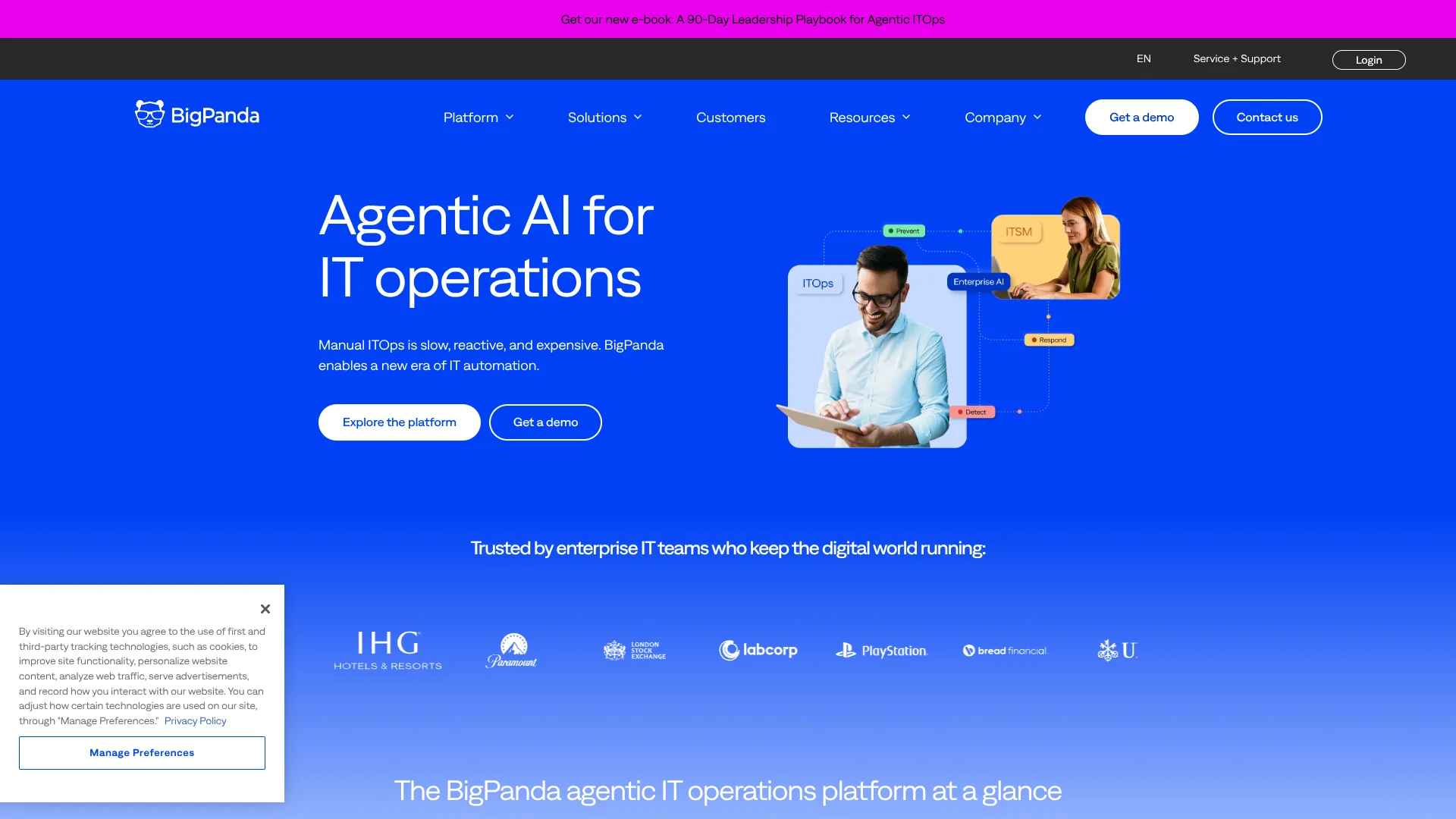
Enterprise IT teams turn alert chaos into unified incidents with BigPanda.
Key Takeaways
- What it is
- Enterprise IT teams turn alert chaos into unified incidents with BigPanda.
- Best for
- AI Detection and Response
- IT Knowledge Graph
- AI Incident Assistant
- Rating
- 4.2/5
What is BigPanda?
BigPanda brings monitoring alerts, service data, changes, and operational knowledge into a shared view of IT incidents. Its AI correlates related alerts, adds context, identifies likely causes, and helps incident teams decide what to do next. The platform is built for enterprise ITOps, IT service management, incident management, and site reliability teams dealing with noisy, fragmented systems.
BigPanda’s IT Knowledge Graph continuously connects services, infrastructure, changes, tickets, and operational data so its AI can reason about relationships instead of treating every alert as an isolated event.
BigPanda fits organizations with complex cloud, on-premises, or hybrid environments and established monitoring stacks. It is less suitable for small teams seeking a self-serve monitoring app or transparent subscription pricing. Its strongest use is turning scattered operational signals into context-rich incidents that teams can investigate and resolve faster.
Who is Using BigPanda?
Incident Managers
Incident managers coordinate response with AI-generated summaries, action plans, status updates, and post-incident reports.
SREs
SREs investigate service dependencies, recent changes, telemetry, and likely root causes from a shared incident view.
NOC Operators
NOC operators handle repetitive detection and triage work through correlated incidents and AI-assisted response.
IT Operations Managers
IT operations managers track incident patterns, automation coverage, and performance through Unified Analytics.
ITSM Administrators
ITSM administrators connect ticketing, CMDB, knowledge, and incident workflows to BigPanda.
Uncommon Use Cases
Change risk analysis before approvals; indexing internal documents and diagrams so Biggy can use them during investigations.
Key Features
Rating Breakdown
Pricing Plans
Customized pricing
- Value-based subscription pricing uses one universal credit pool across BigPanda platform products.
- Tiered credit plans start at 20,000 credits.
- One-, two-, and three-year commitment options are available.
- Unused credits do not carry forward.
Which BigPanda plan should you pick?
Request a customized BigPanda quote if you have an enterprise ITOps use case and want to match credit allocation, products, support, and contract length to your environment.
Customized BigPanda Subscription
Good for enterprise teams that need several BigPanda products, connected operational data, and a credit plan sized to their incident volume.
BigPanda Use Cases
Alert Noise Reduction
Thousands of raw alerts become deduplicated, normalized incidents with related signals grouped together.
Outcome: Responders focus on service-impacting incidents instead of isolated alerts.
Major Incident Investigation
Biggy searches connected operational data and presents findings in natural language during an outage.
Outcome: Teams spend less time gathering context across monitoring, ticketing, and collaboration tools.
L1 Operations Automation
AI agents handle repetitive detection, triage, escalation, and selected response tasks.
Outcome: L1 teams can handle more operational work without adding the same amount of headcount.
Change Risk Management
AI Incident Prevention reviews change and incident patterns to identify changes that could create service risk.
Outcome: Engineering and operations teams can review higher-risk changes before deployment.
Post-Incident Documentation
Incident reports, summaries, and meeting transcripts are generated from the investigation record.
Outcome: Teams leave incidents with clearer documentation and reusable operational knowledge.
Workflow Ideas with BigPanda
From Alert to Incident
- 1Ingest alerts from monitoring and observability tools.
- 2Normalize, deduplicate, and correlate related alerts.
- 3Assign priority and route the resulting incident to responders.
AI-Assisted Major Incident
- 1Open an incident channel or bridge through a connected collaboration tool.
- 2Ask Biggy to investigate services, changes, tickets, and telemetry.
- 3Share findings, action items, and updates with the response team.
Change Risk Review
- 1Ingest change and incident history into the IT Knowledge Graph.
- 2Review AI-identified relationships and potential service impact.
- 3Use the findings to support change approval or additional safeguards.
How BigPanda fits into your stack
Monitoring and observability
BigPanda sits above monitoring and observability tools, collecting alerts and telemetry from systems such as Datadog, Dynatrace, Grafana, New Relic, Prometheus, Splunk, and ThousandEyes.
ITSM and service desks
ServiceNow, Jira, and BMC Remedy integrations connect incidents with tickets, service ownership, and service workflows.
Collaboration and on-call
Biggy can work with Slack, Microsoft Teams, Webex, Zoom, PagerDuty, OpsGenie, Grafana OnCall, Everbridge, Jira Service Management, and MIR3.
Knowledge and context
The IT Knowledge Graph combines operational data, documents, service relationships, changes, and other context for AI-assisted investigation.
Automation and APIs
Public APIs, webhooks, runbook tools, and custom integrations support two-way data exchange and automated response workflows.
Pros
- +Incident context: Connects alerts, changes, services, and knowledge before responders begin investigating.
- +AI investigation: Biggy can search operational data, summarize findings, and support incident action plans.
- +Integration breadth: Supports monitoring, observability, ITSM, collaboration, on-call, source control, and knowledge tools.
- +Enterprise controls: Includes SSO, role-based access, API keys, audit capabilities, and encryption at rest and in transit.
- +Custom automation: Public APIs and configurable workflows support two-way integrations and repeatable response steps.
Cons
- −Enterprise buying process: Pricing is quote-based and tied to credits and contract commitments.
- −Setup effort: Teams need to connect operational data sources and configure integrations before the AI has useful context.
- −Narrow audience: The product is built for enterprise IT operations rather than individual users or small software teams.
Limitations & when to consider alternatives
Known limitations
- Quote-based pricing. BigPanda uses value-based subscription pricing with a universal credit pool and one- to three-year commitment options.
- AI Incident Assistant historical data. AI Incident Assistant cannot currently search or retrieve historical incident data from Unified Analytics.
- On-premises connections. Many on-premises integrations require the Relay Client so BigPanda can communicate securely without exposing internal infrastructure.
- Unused credits. Unused credits do not carry forward, although remaining credits can be used across BigPanda platform products.
- Enterprise administration. The platform requires configuration of integrations, roles, data sources, workflows, and security settings before broad rollout.
Look elsewhere when
- You need a self-serve monitoring product with public monthly pricing.
- You want a native mobile app for incident response.
- Your team needs a general-purpose AI tool for writing, coding, or research.
- Your organization does not have enough operational data or integrations to support an enterprise ITOps rollout.
How to Use BigPanda
- 1
Connect operational sources
Configure monitoring, observability, ITSM, collaboration, change, and knowledge integrations so BigPanda can build incident context.
- 2
Set roles and access
Create users, assign roles, and configure SSO or API keys for controlled access.
- 3
Review correlated incidents
Start with normalized incidents that combine related alerts and show service, topology, and change context.
- 4
Add AI Incident Assistant
Connect Biggy to BigPanda and selected tools so responders can investigate incidents through chat and action plans.
- 5
Configure workflows
Create keyword-based or scheduled workflows for recurring investigation, communication, and response tasks.
- 6
Measure operational results
Use Unified Analytics to track incident trends, monitoring data, and the way teams use automation.
Who is BigPanda For?
Enterprise IT Operations
Large ITOps organizations can reduce alert noise and coordinate response across complex infrastructure.
Incident Management Teams
Major incident teams gain shared context, automated updates, and AI support during active outages.
IT Service Management
ITSM groups can connect incidents with ServiceNow, Jira, BMC Remedy, and related service workflows.
Site Reliability Engineering
SRE teams can investigate service relationships, changes, and telemetry without relying on separate data silos.
Managed Service Providers
MSPs can automate repetitive L1 operations and support incident response across customer environments.
Frequently Asked Questions
Does BigPanda offer a free plan?
BigPanda does not publish a free plan. Prospective customers request a customized quote.
How is BigPanda priced?
BigPanda uses value-based subscription pricing with a universal credit system. Tiered credit plans start at 20,000 credits and use one- to three-year commitments.
Does BigPanda have an API?
Yes. BigPanda provides public APIs for managing incidents, configuring platform elements, sending data, and building two-way integrations.
Does BigPanda support SSO?
Yes. Organizations can configure single sign-on through a third-party identity provider.
Can Biggy analyze uploaded files?
Yes. AI Incident Assistant can analyze uploaded images, CSV files, and Word documents, and organizations can upload documents as additional context.
Which tools integrate with BigPanda?
BigPanda supports tools across monitoring, observability, ITSM, collaboration, on-call, source control, CMDB, and knowledge management, including ServiceNow, Jira, Slack, Microsoft Teams, Datadog, Splunk, GitHub, and PagerDuty.
Community reviews
Be the first to share your experience.
Sign in to leave a review for BigPanda.
BigPanda Alternatives
Looking for alternatives to BigPanda? Here are similar tools in the same category: