BigID
Sensitive-data discovery and access risk management for large, regulated organizations.
Key Takeaways
- What it is
- Sensitive-data discovery and access risk management for large, regulated organizations.
- Best for
- Discovery in Depth
- AI-Powered Classification
- AI and Agent Discovery
- Rating
- 4.1/5
What is BigID?
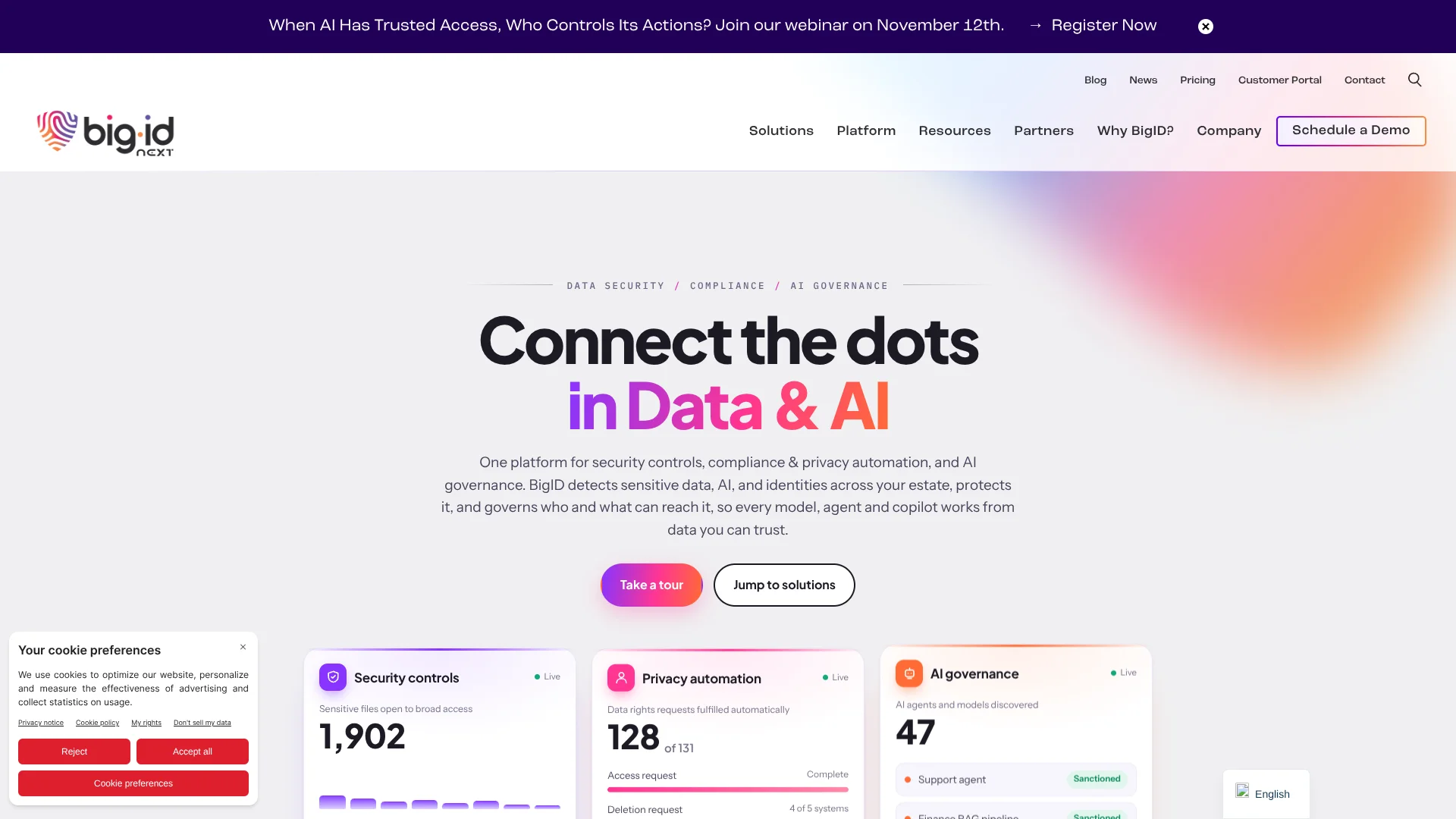
BigID finds sensitive, personal, regulated, proprietary, and AI-connected data across cloud, SaaS, on-premises, hybrid, structured, unstructured, and semi-structured environments. Security, privacy, compliance, data governance, and AI teams use it to understand what data exists, who or what can reach it, and which action should happen next.
BigID connects data sensitivity with identity, access, activity, ownership, lineage, policy, and AI context, so a sensitive-data finding can become a prioritized access decision or remediation workflow instead of another isolated report.
BigID is best suited to larger organizations with complex data estates and strict privacy or security requirements. Its enterprise scope also brings a steeper setup and a sales-led buying process, so smaller teams seeking a lightweight scanner may find it too involved.
Who is Using BigID?
Chief Information Security Officers
Risk context across data, identity, access, and AI helps security leaders prioritize the exposures with the greatest business impact.
Privacy Officers
Personal-data discovery and privacy workflows support data rights, processing records, assessments, retention, and deletion.
Data Protection Engineers
Scan controls, classifiers, policy rules, and remediation actions turn sensitive-data findings into repeatable controls.
AI Governance Leaders
Agent inventories, data reach maps, AI risk assessments, and policy enforcement help govern enterprise AI adoption.
Data Governance Managers
Ownership, classification, lineage, and business context make data catalogs and governance decisions more useful.
Uncommon Use Cases
Classifying data inside RAG pipelines and vector stores; scanning streaming data from Kafka and Kinesis
Key Features
Rating Breakdown
Pricing Plans
Custom Pricing Model
- Pricing depends on the number of data sources, apps, and connectors.
- Deployment type and services or support level also affect the quote.
- The official pricing page offers a free trial request.
Which BigID plan should you pick?
Start with a free trial request to validate connector coverage and scan needs, then ask BigID for a quote based on your sources, deployment, and support requirements.
Custom Pricing Model
For organizations that need enterprise data discovery, privacy, security, AI governance, remediation, and deployment options tailored to their environment.
BigID Use Cases
Sensitive Data Discovery
An inventory of personal, regulated, confidential, proprietary, and high-risk data spans cloud, SaaS, on-premises, and AI-connected sources.
Outcome: A current view of what sensitive data exists and where it lives.
AI Security Readiness
AI assets, agents, prompts, retrieval sources, and model-connected data are assessed before they create unnecessary exposure.
Outcome: A clearer map of what each AI system can access.
Access Risk Reduction
Permissions and activity are evaluated against data sensitivity, ownership, and business context to find excessive access.
Outcome: Prioritized access changes that support least privilege.
Privacy Operations
Data rights requests, deletion, processing records, privacy assessments, and policy checks are tied to discovered data.
Outcome: More repeatable privacy fulfillment and audit evidence.
Automated Remediation
Policy violations can route to owners, create tickets, trigger approvals, revoke access, quarantine data, or start other corrective actions.
Outcome: A closed-loop path from finding to tracked resolution.
Workflow Ideas with BigID
Prepare an AI Assistant Rollout
- 1Scan the sources connected to the planned assistant.
- 2Classify sensitive files, messages, records, prompts, and retrieval sources.
- 3Reduce excessive access and verify the assistant's remaining data reach.
Remediate Sensitive Data Exposure
- 1Define a policy for sensitive data, access, ownership, or location.
- 2Prioritize violations using sensitivity, activity, and business context.
- 3Assign remediation, create tickets, and track the action through resolution.
Automate a Privacy Request
- 1Verify the data subject through the Privacy Portal API.
- 2Search connected sources for matching personal data.
- 3Create and retrieve the secure personal data report or trigger deletion.
How BigID fits into your stack
Cloud and Data Sources
BigID sits above databases, warehouses, data lakes, SaaS applications, file shares, collaboration tools, developer systems, and AI data stores to build a shared inventory.
Security and Identity
Sensitivity findings gain context from identities, permissions, service accounts, applications, activity, and AI agents. This helps security teams prioritize access reduction and policy enforcement.
Privacy and Governance
Discovery feeds data rights, consent, processing records, retention, deletion, assessments, ownership, lineage, and compliance reporting.
Service Management
Integrations such as ServiceNow can receive classification, ownership, and risk context, then create incident or issue-triage workflows for remediation.
AI and Developer Workflows
The BigID API, custom connectors, Apps framework, and MCP support connect data intelligence to custom applications, Claude, ChatGPT, Copilot, Gemini, and internal automation.
Reporting and Analytics
Findings can feed S3, BigQuery, Snowflake, Databricks, Power BI, Looker, and Tableau for reporting and audit work.
Pros
- +Broad coverage: Connects to hundreds of cloud, SaaS, database, file, developer, collaboration, and AI sources.
- +AI data visibility: Shows which models and agents can reach sensitive data, including data in prompts, vector stores, and RAG pipelines.
- +Custom classification: Teams can train custom models, define natural-language classification prompts, and bring an approved AI model.
- +Enterprise deployment: Supports SaaS, single-tenant cloud, self-managed, hybrid, and air-gapped environments.
- +Open platform: APIs, custom connectors, apps, and MCP connections extend BigID into existing workflows.
Cons
- −Opaque pricing: The official pricing page does not publish a US list price.
- −Enterprise complexity: The range of discovery, governance, and remediation controls may require specialist ownership.
- −Sales-led evaluation: The normal path is a demo or free trial request rather than immediate self-serve access.
Limitations & when to consider alternatives
Known limitations
- Pricing depends on environment size. BigID says pricing depends on data sources, apps, connectors, deployment type, and services or support level.
- Scan capacity varies by cloud level. BigID Cloud uses cloud levels with different permitted monthly scan volumes and scan speeds.
- Connector coverage is source-specific. BigID supports hundreds of connectors, but unsupported sources require a custom connector or another integration path.
- Deployment choice affects operations. SaaS, self-managed, hybrid, and air-gapped deployments place different responsibilities on the customer for hosting, configuration, and connected systems.
Look elsewhere when
- You need a low-cost self-serve data scanner with public monthly pricing.
- You need a native mobile app or desktop client for individual work.
- Your data sources are not covered and you cannot build or commission a custom connector.
- Your team wants a lightweight tool without enterprise deployment and governance administration.
How to Use BigID
- 1
Choose the deployment model
Select SaaS, single-tenant cloud, self-managed, hybrid, or air-gapped deployment based on residency, isolation, and operating requirements.
- 2
Connect data sources
Add databases, cloud storage, SaaS applications, file systems, developer tools, collaboration systems, and AI platforms through built-in or custom connectors.
- 3
Set scan depth
Start with metadata or smart sampling, then run full scans where the findings justify deeper inspection.
- 4
Tune classification
Review findings, refine categories, define natural-language prompts, or train custom models so results match your data and policies.
- 5
Prioritize risk
Connect sensitivity to identity, permissions, ownership, activity, lineage, location, and business context to find the issues that matter most.
- 6
Automate action
Route findings into assignments, approvals, tickets, access changes, deletion, quarantine, policy enforcement, or reporting workflows.
Who is BigID For?
Security Teams
Sensitive-data discovery, access intelligence, activity monitoring, and remediation help reduce exposure across complex environments.
Privacy and Compliance Teams
Data mapping, data rights, deletion, consent, assessments, and policy reporting support privacy programs.
AI Governance Teams
AI asset discovery and data-access mapping help teams assess copilots, agents, models, and AI pipelines before and after deployment.
Data Governance Teams
Classification, ownership, lineage, policy enforcement, and reporting improve trust in enterprise data.
Large Regulated Organizations
Deployment choices that include on-premises and air-gapped environments fit organizations with residency or isolation requirements.
Frequently Asked Questions
Does BigID have a free plan?
BigID's official pricing page offers a free trial request, but it does not publish a permanent free tier.
How much does BigID cost?
BigID does not publish a US list price. Pricing depends on data sources, apps, connectors, deployment type, and services or support.
Does BigID have an API?
Yes. The BigID API can create data sources, configure and run scans, execute data rights requests, export metadata, scan data in motion, and find duplicate data.
What integrations does BigID support?
Examples include AWS, Snowflake, Databricks, BigQuery, Salesforce, ServiceNow, Slack, Microsoft Teams, SharePoint, Google Drive, Jira, Confluence, Tableau, Power BI, Kafka, OpenAI, and Vertex AI.
Can BigID run in an air-gapped environment?
Yes. BigID says it supports self-managed, on-premises, private-cloud, hybrid, and fully disconnected deployments.
Does BigID encrypt customer data?
Yes. BigID states that it encrypts data at rest and in transit using AES-256, SSH, and TLS 1.2 or higher.
Community reviews
Be the first to share your experience.
Sign in to leave a review for BigID.
BigID Alternatives
Looking for alternatives to BigID? Here are similar tools in the same category: