Applied Intuition
Simulation software lets automakers test self-driving systems before real-world deployment.
Key Takeaways
- What it is
- Simulation software lets automakers test self-driving systems before real-world deployment.
- Best for
- Dana
- Tools for Vehicle Intelligence
- Simulation and evaluation
- Rating
- 4.0/5
What is Applied Intuition?
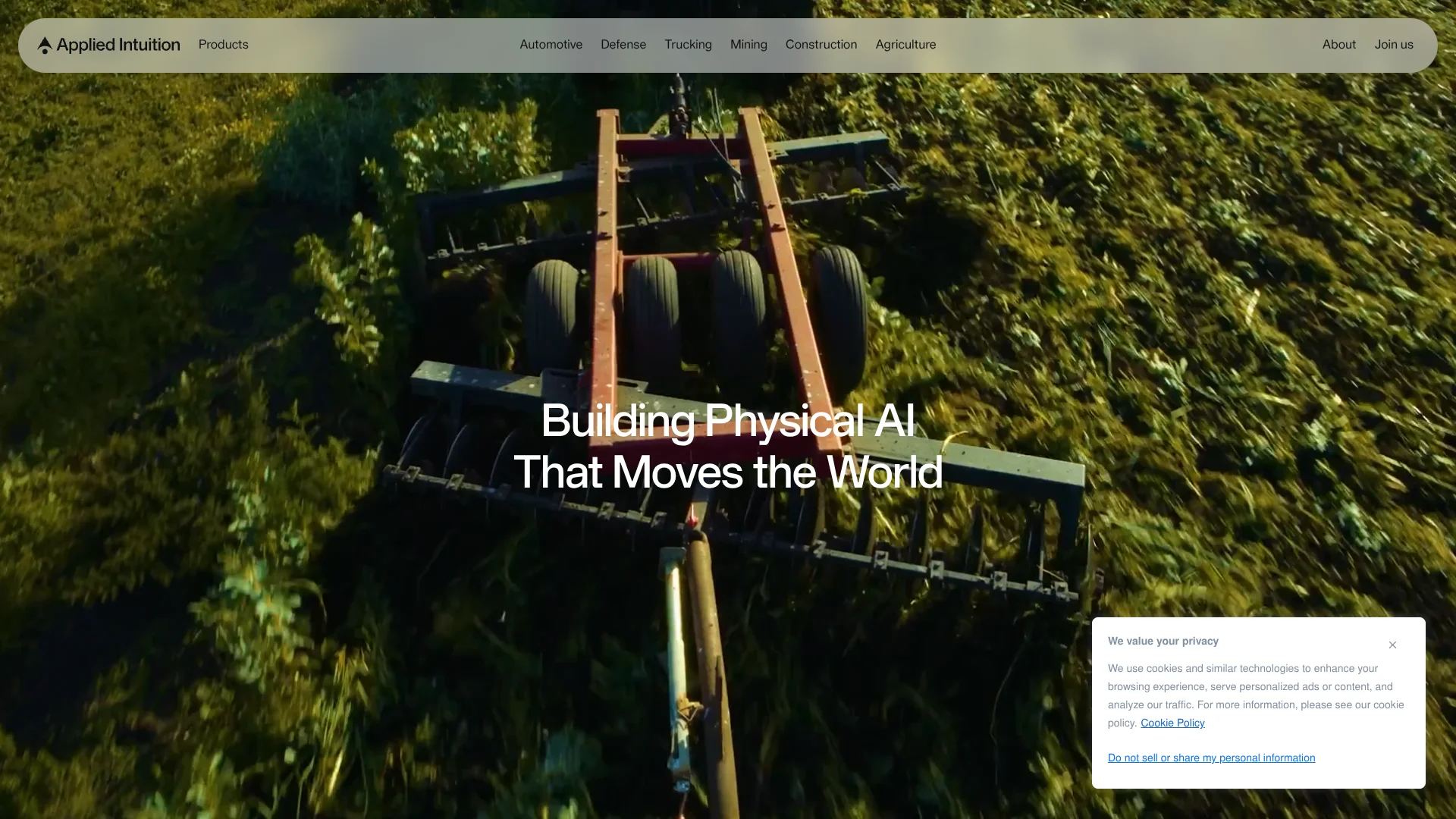
Applied Intuition helps vehicle makers and industrial teams build, test, and operate machines that use AI in the real world. Its offerings include Dana, a platform for physical AI development, Tools for Vehicle Intelligence for processing data and validating systems, a Self-Driving System, and Vehicle OS. The goal is to help teams develop autonomy and machine software and check its performance before and after deployment.
Dana brings agent-driven workflows to physical AI engineering: teams can work through natural-language or command-line interfaces across data curation, simulation, and evaluation, with results traced through the workflow.
The company is best suited to organizations developing vehicles, fleets, or other safety-critical machines, not people looking for a general-purpose chatbot. Its products are specialized and the site does not publish self-serve prices, so expect a technical, sales-led evaluation.
Who is Using Applied Intuition?
Autonomy engineers
Simulation, data curation, and evaluation help them test machine behavior before deployment.
Vehicle software engineers
Vehicle OS provides a software foundation with system metrics and diagnostics.
Data and machine learning engineers
Curated sensor data can support model training, inference, simulation, and evaluation workflows.
Fleet operations teams
Self-Driving System capabilities support deploying, monitoring, and managing autonomous fleets.
Uncommon Use Cases
Defense teams can test autonomous systems in virtual environments; construction and mining operators can coordinate mixed fleets across job sites.
Key Features
Rating Breakdown
Pricing Plans
Custom Pricing Model
- Applied Intuition offers tailored pricing based on specific industry needs and scale of deployment
Which Applied Intuition plan should you pick?
Contact Applied Intuition to identify the right product mix and discuss pricing, since the official site does not publish self-serve plans.
Applied Intuition Use Cases
Test autonomy before deployment
Virtual simulation lets engineering teams evaluate autonomous systems across scenarios before testing them on real machines.
Outcome: Earlier testing without relying only on real-world test events.
Turn sensor data into development material
Curated and labeled segments from real-world sensor data can feed model training, simulation, and evaluation.
Outcome: A closed loop from fleet data to system improvement.
Develop vehicle software
Vehicle OS gives teams a common software foundation for machine systems, with built-in metrics and diagnostics.
Outcome: Reduced cross-domain integration effort, according to Applied Intuition.
Build and operate physical AI applications
Dana supports development workflows from data and testing through deployment and operation.
Outcome: A path from physical AI development to operating intelligent machines.
Coordinate autonomous fleets
Self-Driving System supports deploying, monitoring, and commanding fleets of autonomous vehicles and machines.
Outcome: Management of autonomous machines across operational settings.
Workflow Ideas with Applied Intuition
Validate an autonomy change
- 1Select relevant real-world sensor data or scenarios.
- 2Run simulation and evaluation on the autonomy system.
- 3Review results and trace them through the workflow.
Build a data-to-model loop
- 1Collect or ingest sensor data from machines.
- 2Curate and label useful data segments.
- 3Send the segments into training, simulation, or evaluation.
Coordinate an autonomous fleet
- 1Prepare the autonomy system for the target machines and environment.
- 2Deploy the system to the fleet.
- 3Monitor and manage machines during operations.
How Applied Intuition fits into your stack
Data and model development
Tools for Vehicle Intelligence processes sensor data for downstream training, simulation, and evaluation. Teams can bring their own models and metrics.
Simulation and validation
Simulation and evaluation help engineering teams check physical AI systems in virtual environments before field deployment.
Machine software
Vehicle OS provides a software foundation for machine systems, with onboard software, off-board services, and cloud tooling.
Engineering workflows
Dana offers natural-language and command-line access to physical AI workflows and can integrate with Slack and Jira.
Fleet operations
Self-Driving System supports deployment, monitoring, and command of autonomous vehicle and machine fleets.
Pros
- +Physical-world focus: Its products address AI development for vehicles, fleets, and other machines rather than only digital tasks.
- +Data-to-testing workflow: Real-world sensor data can feed curation, simulation, and evaluation.
- +Flexible deployment: The platform supports cloud, on-premises, and air-gapped environments.
- +Security and safety evidence: The company lists security certifications and safety documentation for customers.
Cons
- −Specialized scope: It is aimed at machine and vehicle engineering, not everyday writing or research.
- −Sales-led buying: Prospective customers need to contact the company to discuss products and deployment.
- −Technical adoption: Teams may need vehicle, autonomy, or software engineering expertise to make use of the platform.
Limitations & when to consider alternatives
Known limitations
- Enterprise-oriented access. The public site directs prospective users to request product information or a demo rather than offering self-serve public pricing.
- Limited early access for Dana. Applied Intuition says Dana initially had limited, early access for select customers.
- Safety-critical domain complexity. The platform is designed for complex, safety-critical machines and requires specialized engineering workflows.
- Browser-based tooling. Applied Intuition describes its product suite as browser-based rather than as a downloadable desktop application.
Look elsewhere when
- You need a native desktop application.
- You need publicly listed pricing and plans.
- You need a general-purpose document or coding assistant.
How to Use Applied Intuition
- 1
Identify the engineering need
Decide whether your project centers on simulation and data, autonomy software, Vehicle OS, or Dana.
- 2
Discuss deployment requirements
Contact Applied Intuition with your product interest and whether your environment requires cloud, on-premises, or air-gapped deployment.
- 3
Bring your team’s data and systems
For Tools for Vehicle Intelligence, the platform is designed to work with real-world sensor data and lets teams bring their own models, simulators, and metrics.
- 4
Set up a development workflow
Use Dana’s natural-language or command-line interfaces and connect relevant engineering workflows, such as Slack or Jira.
- 5
Evaluate before deployment
Run simulation and evaluation workflows, then review their results and traceability before moving systems into real-world use.
Who is Applied Intuition For?
Automotive manufacturers
Vehicle programs can use its software, autonomy systems, and validation tools to develop intelligent vehicles.
Defense organizations
Teams developing autonomous systems can evaluate them in simulated environments and manage data from fielded systems.
Trucking and fleet operators
Organizations can develop autonomy and coordinate software across commercial vehicle fleets.
Construction, mining, and agriculture
Equipment makers and operators can build autonomy and software for machines working in demanding outdoor settings.
Robotics teams
Teams building robots can use Dana and the company’s physical AI development tools.
Frequently Asked Questions
Does Applied Intuition have a free plan?
The official site does not list a free plan. It directs prospective customers to contact the company for product information and deployment discussions.
How much does Applied Intuition cost?
The official site does not publish plan prices. Contact Applied Intuition to discuss pricing for your products and deployment needs.
Does Applied Intuition integrate with Slack or Jira?
Yes. Applied Intuition names Slack and Jira as examples of enterprise systems and collaboration tools that Dana can integrate with.
Can teams deploy the platform on-premises?
The Tools for Vehicle Intelligence SDK supports workflows across cloud, on-premises, and air-gapped environments.
What industries does Applied Intuition serve?
The company lists automotive, defense, trucking, mining, construction, and agriculture, and Dana also addresses robotics.
Community reviews
Be the first to share your experience.
Sign in to leave a review for Applied Intuition.
Applied Intuition Alternatives
Looking for alternatives to Applied Intuition? Here are similar tools in the same category: