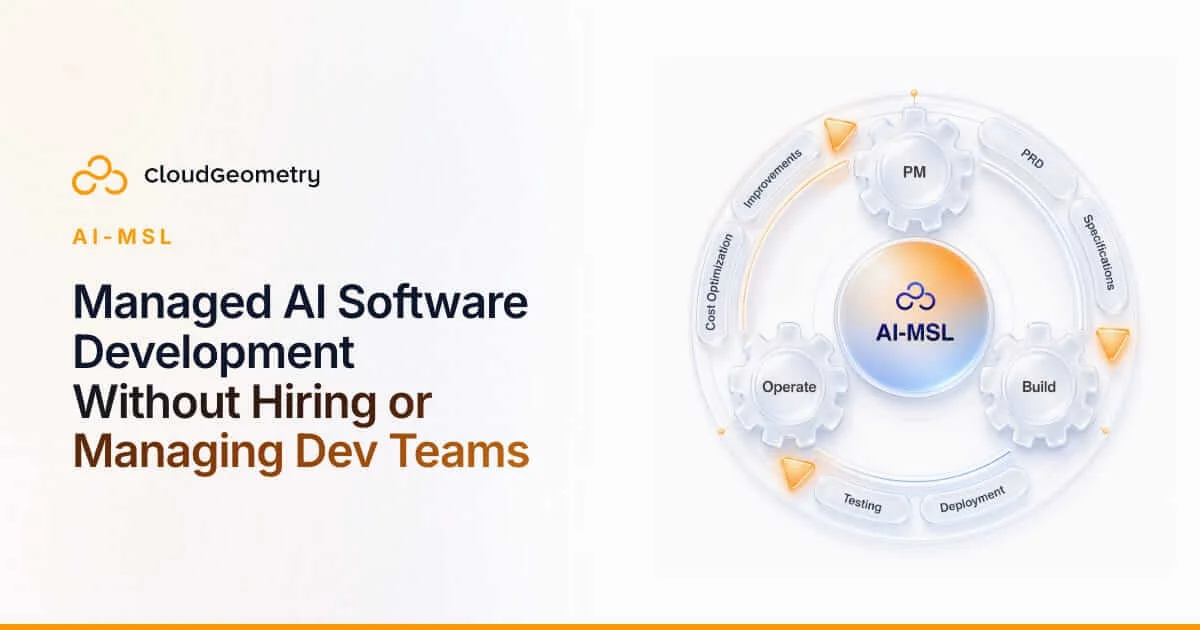
AI MSL
Managed software changes for teams maintaining existing systems, with engineers overseeing AI.
Key Takeaways
- What it is
- Managed software changes for teams maintaining existing systems, with engineers overseeing AI.
- Pricing
- $5,000 per month · $20,000 per month
- Best for
- AppGraph
- Product Management Portal
- DevCredit estimates
- Rating
- 4.1/5
What is AI MSL?
AI-MSL turns a change request for an existing software system into a scoped, estimated, tested code change, with engineers supervising the work. Product and technology leaders use its workspace to refine requirements, approve a plan, and track delivery. AppGraph maps a system’s code, architecture, dependencies, and other engineering knowledge so each change can be planned in the context of the software it will affect.
AppGraph gives AI-MSL a maintained model of the whole system, not just the files involved in one request. That context informs impact analysis and helps AI-generated changes follow existing architecture, while AI-MSL Engineers review and sign off on changes.
AI-MSL is best suited to organizations that already run software and want managed help maintaining, modernizing, or extending it. It is not intended for building a first product from scratch, and its service model may be more than a small team needs. Its clearest fit is software teams seeking governed delivery without having to coordinate every development step themselves.
Who is Using AI MSL?
Product managers
Turn high-level feature goals into validated requirements, impact analysis, and a PRD for approval.
Software engineering leaders
Review system impact, monitor governed delivery, and retain visibility into engineering decisions.
Customer success managers
Translate customer-driven requests into scoped changes with an estimate before implementation.
Operations teams
Submit operational improvements and follow them through review, testing, and delivery.
Uncommon Use Cases
Preserve system knowledge during an engineering team transition; assess modernization opportunities before committing to a rebuild.
Key Features
Rating Breakdown
Pricing Plans
MSL One
$5,000 per month
- 5,000 DevCredits in monthly reserved capacity
- Secure CloudGeometry AWS instance
- AppGraph, requirements finalization, and change estimates
- Standard support and shared AI Lifecycle Manager support
MSL Pro
$20,000 per month
- 20,000 DevCredits in monthly reserved capacity
- Dedicated instance on AWS, Azure, or Google Cloud
- Dedicated AI Lifecycle Manager and engineer supervision options
- SAML/SSO, VPN or PrivateLink, IP allowlists, and log export
MSL Enterprise
- Sized to your portfolio
- Deployment in your cloud or data center
- Integration with your IAM, KMS, secrets, and SIEM
- 24/7 support
Maintenance
- Optional package available on every plan
- Proactive security, dependency, and framework maintenance
Release Management
- Optional package available on every plan
- Release readiness, merge and deploy handoff, and release evidence
Test Environments
- Optional package available on every plan
- Integration with a test environment or setup of a new one with validation
Deployment and Hosting
- Optional package available on every plan
- Kubernetes-based Control Plane hosting with 24/7 production support for software built by MSL
Which AI MSL plan should you pick?
Start with MSL One for a stable production system, choose MSL Pro for an active roadmap and dedicated infrastructure, and consider MSL Enterprise when your organization needs deployment and governance inside its own environment.
MSL One
For SMBs maintaining a production system with 5,000 monthly DevCredits and shared AI Lifecycle Manager support.
MSL Pro
For growing product teams that need 20,000 monthly DevCredits, a dedicated instance, and a dedicated AI Lifecycle Manager.
MSL Enterprise
For large or regulated organizations that need on-premises or customer-cloud deployment, integrated governance, and 24/7 support.
AI MSL Use Cases
New feature development
A feature request is checked against AppGraph, then scoped, estimated, implemented, and tested through a supervised process.
Outcome: A tested code change prepared for review and merging.
Software maintenance
Routine security, dependency, and framework updates are managed alongside agreed maintenance work.
Outcome: Software kept current and ready for future changes.
Application modernization
System assessment identifies dependencies, risks, and modernization opportunities before a team commits to implementation.
Outcome: A prioritized modernization roadmap and effort estimates.
AI and technology adoption
AppGraph helps teams assess how a proposed technology or AI initiative fits their existing system.
Outcome: System impact and implementation effort assessed before development.
Engineering knowledge retention
Code, documentation, architecture, procedures, and team knowledge are organized into a searchable system model.
Outcome: A reusable knowledge base for future changes and team transitions.
Workflow Ideas with AI MSL
Deliver a customer-requested feature
- 1Describe the requested change in the AI-MSL workspace.
- 2Review the refined requirements, system impact, timeline, and DevCredit estimate.
- 3Approve the PRD and track supervised implementation through testing and delivery.
Assess a legacy application
- 1Connect a GitHub, GitLab, or Bitbucket repository, or provide a repository archive.
- 2Add available engineering materials such as architecture diagrams or API specifications.
- 3Review AppGraph, system quality findings, risks, and modernization recommendations.
Maintain a production system
- 1Set the maintenance scope for security, dependency, and framework updates.
- 2Review proposed work and its system impact.
- 3Track engineer-reviewed changes and their audit records.
How AI MSL fits into your stack
Source repositories
AI-MSL connects to GitHub, GitLab, or Bitbucket repositories, or accepts a repository archive for assessment. Generated changes are prepared for your repository and deployment workflow.
Engineering knowledge
AppGraph organizes code, architecture, APIs, infrastructure, procedures, and other system information into context for planning changes.
Product and change planning
The Product Management Portal supports requirements refinement, PRD approval, change tracking, and estimates before development begins.
Cloud and enterprise environments
MSL One runs on CloudGeometry’s AWS environment; Pro supports a dedicated AWS, Azure, or Google Cloud instance, and Enterprise can run in a customer environment.
Pros
- +System-wide context: AppGraph maps dependencies and architecture to help assess how a proposed change affects existing software.
- +Cost before work: Each change receives a DevCredit estimate before you approve it.
- +Engineer sign-off: An AI-MSL Engineer reviews and signs off on every change.
- +Code ownership: Your code and generated engineering assets remain yours, and delivery is prepared for your repositories.
- +Deployment choices: Plans range from a CloudGeometry-hosted service to dedicated or enterprise environments.
Cons
- −High monthly commitment: The listed MSL One price starts at $5,000 per month, making it a substantial service for smaller teams.
- −Managed-service model: AI-MSL includes engineering oversight, so it is not a self-serve coding tool.
- −Existing software required: The vendor says AI-MSL is for managing existing software, not building a first product from scratch.
Limitations & when to consider alternatives
Known limitations
- Requires an existing software system. The pricing page says AI-MSL manages existing software and is probably not a fit for a product that has not started running in production or is being built from nothing.
- Not fully self-serve. The service includes an AI Lifecycle Manager and AI Lifecycle Engineers who oversee delivery.
- Over-capacity changes cost extra. Changes above the plan’s monthly reserved capacity are billed according to the estimate for each authorized change.
Look elsewhere when
- You need a tool for building a first product from scratch.
- You want a self-serve coding assistant without managed engineering oversight.
- Your team needs a low-cost subscription rather than a managed software lifecycle.
How to Use AI MSL
- 1
Start with a system assessment
Choose an existing application and provide access to its repository so AI-MSL can build AppGraph and establish a baseline.
- 2
Add relevant engineering assets
Include available diagrams, product documents, API specifications, infrastructure definitions, or operating procedures to enrich the system model.
- 3
Submit a change request
Describe the business goal or operational improvement in the workspace; AI-MSL helps refine requirements and identify edge cases.
- 4
Review scope and estimate
Check the proposed PRD, system impact, timeline, and DevCredit estimate before authorizing development.
- 5
Follow governed delivery
Track specifications, implementation, testing, and documentation as AI-MSL Engineers supervise the lifecycle.
- 6
Review the delivered branch
Inspect the tested change and its supporting evidence before merging it into your repository.
Who is AI MSL For?
Small and midsize businesses
MSL One is positioned for teams maintaining a stable production system and handling routine updates or occasional features.
Growing product companies
MSL Pro is aimed at active roadmaps, monthly releases, and multiple workstreams that need ongoing delivery.
Regulated and large organizations
MSL Enterprise supports deployment in a company’s cloud or data center with its own governance and audit systems.
Product and technology leaders
The workspace helps leaders submit changes, review requirements, and follow delivery without coordinating every engineering task.
Frequently Asked Questions
Does AI-MSL have a free plan?
The official pricing page lists paid reserved-capacity plans and a custom-priced Enterprise plan, not a free plan.
How much does AI-MSL cost?
MSL One is $5,000 per month and MSL Pro is $20,000 per month. MSL Enterprise is custom-priced, and each plan’s reserved capacity renews monthly.
What happens when I use more than my reserved capacity?
Each proposed change is estimated before authorization; work above the reserved capacity is billed by its authorized change estimate.
Which repositories can AI-MSL connect to?
The assessment process lists GitHub, GitLab, and Bitbucket, and also allows a repository archive to be uploaded.
Can AI-MSL run in our own environment?
MSL Enterprise supports deployment in your cloud account or data center. MSL Pro offers a dedicated instance on AWS, Azure, or Google Cloud.
Does AI-MSL use customer code to train AI models?
CloudGeometry says customer code and data are not used to train external models or AI models.
Community reviews
Be the first to share your experience.
Sign in to leave a review for AI MSL.
AI MSL Alternatives
Looking for alternatives to AI MSL? Here are similar tools in the same category: