
Adaptive
Revolutionize business AI with tailored, private, fast model tuning.
Key Takeaways
- What it is
- Revolutionize business AI with tailored, private, fast model tuning.
- Best for
- Model Adaptation with RLHF & RLAI
- Fast Inference
- Automated A/B Testing
- Rating
- 4.5/5
What is Adaptive?
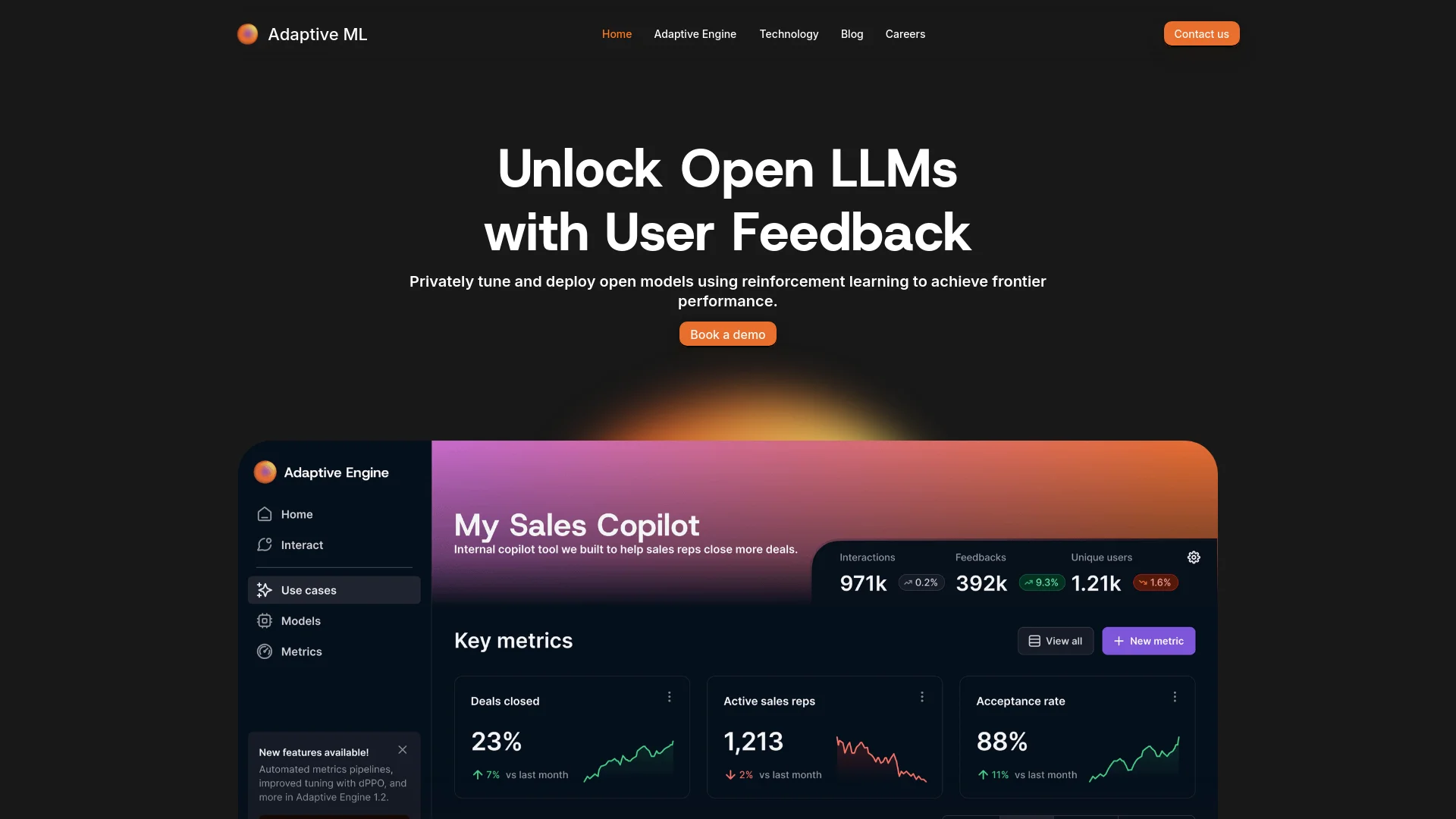
Adaptive is an advanced AI tool designed to transform how businesses leverage large language models (LLMs). It provides a suite of tools for fine-tuning and deploying open models using reinforcement learning techniques, which enhances their performance and ensures they meet specific business needs while safeguarding user privacy. Adaptive is tailored for businesses aiming to boost their generative AI capabilities through optimized model adaptation, fast inference, and continuous improvement based on real-time feedback.
Adaptive's standout feature is its capability to deploy and fine-tune state-of-the-art LLMs within private cloud environments, ensuring complete control over data and model adjustments. Its focus on incorporating real-time user feedback and maintaining stringent data privacy makes it a powerful tool for businesses seeking to advance their AI capabilities.
Adaptive excels in delivering advanced, secure, and efficient AI solutions, making it an essential tool for businesses aiming to harness the power of generative AI technologies. Its emphasis on real-time feedback integration and data privacy, combined with its ability to optimize large language models, positions Adaptive as a leading solution in the AI landscape for innovative and forward-thinking organizations.
Who is Using Adaptive?
Tech Companies
Enhancing customer service bots and other AI-driven interactions.
Financial Institutions
Implementing Adaptive for real-time fraud detection and financial analysis.
Healthcare Providers
Personalizing patient interactions and improving diagnostic tools.
Retail Chains
Utilizing Adaptive for dynamic product recommendations and customer engagement.
Uncommon Use Cases
Non-profits using Adaptive for automating grant writing; academic institutions incorporating it into research and data analysis.
Key Features
Rating Breakdown
Pricing Plans
Free Trial
- Offers a 30-day free trial for new users to explore its capabilities
Enterprise Custom Solutions
- Provides tailored pricing based on organizational needs and scale
Adaptive Use Cases
Enterprise search
Enable access to enterprise knowledge at scale with specialized retrieval systems.
Outcome: Improve retrieval accuracy and reduce hallucinations.
Business intelligence
Build specialized agents that interface with databases through natural language.
Outcome: Accelerate business analytics.
Customer support
Deploy personalized autonomous agents for customer-service interactions.
Outcome: Improve CSAT and reduce escalation rates.
Document RAG
Fine-tune models on company documents and production feedback for retrieval-augmented generation.
Outcome: Improve factuality and helpfulness.
Multimodal document extraction
Fine-tune and serve vision-language models that extract structured fields from scans, forms, receipts, and invoices.
Outcome: Convert image-heavy documents into structured outputs.
Workflow Ideas with Adaptive
Fine-tune and evaluate a specialized model
- 1Create a use case
- 2Deploy a base model and upload training data
- 3Run supervised fine-tuning and test the resulting model
Launch a custom training recipe
- 1Define a recipe with inputs and an entrypoint
- 2Upload the recipe through the SDK
- 3Launch a run with a dataset, model, and grader
Improve a production agent with feedback
- 1Log interactions and collect response feedback
- 2Evaluate models with bespoke AI judges
- 3Feed production signals back into training and deployment
How Adaptive fits into your stack
Cloud Compatibility
Works across various cloud platforms, offering flexibility and scalability.
API Integration
Integrates seamlessly with existing LLM APIs for smooth transitions.
Custom Development
Supports custom development through a unified Rust+Python codebase.
Feedback Systems Integration
Incorporates user feedback directly into the model learning loop for continuous improvement.
Pros
- +Enhanced Performance: Reinforcement learning techniques help models excel in their specific tasks, delivering superior performance.
- +Data Privacy: By running models in a private cloud environment, Adaptive ensures that sensitive data is kept secure.
- +Scalability: Suitable for both small-scale experiments and extensive deployments, accommodating diverse business needs.
- +User Feedback Integration: Facilitates real-time improvements based on direct user feedback, enhancing model relevance and effectiveness.
Cons
- −Complex Technology: The sophisticated nature of reinforcement learning may require a learning curve for users unfamiliar with the technology.
- −Higher Resource Requirement: Advanced technology may demand more robust computing resources.
- −Limited to LLMs: Focuses primarily on large language models, which might not address all potential AI applications.
Limitations & when to consider alternatives
Known limitations
- External model credentials are required. Connecting proprietary external models requires supplying a valid external provider API key.
- Gated Hugging Face models require prior access. Users must already have access to gated models through their Hugging Face account.
- Custom recipe directories require main.py. When uploading a recipe directory, the file containing the recipe entrypoint must be named main.py.
- Direct PDF ingest is not yet available. The product roadmap lists direct PDF ingestion as a future improvement; PDFs currently need conversion to images for multimodal processing.
Look elsewhere when
- You need a native mobile application.
- You need a browser extension.
- You need a publicly listed self-serve pricing plan.
How to Use Adaptive
- 1
Detailed guides and tutorials are available on Adaptive's official website, covering everything from initial setup to advanced model tuning and integration.
Who is Adaptive For?
Enterprise AI teams
Adaptive Engine is designed to help enterprises build, own, and deploy specialized intelligence layers.
Customer support organizations
Customer-support teams can build specialized autonomous agents and optimize them using production feedback.
Business intelligence teams
Business intelligence teams can use specialized agents to interface with databases using natural language.
Enterprise search teams
Search teams can improve retrieval accuracy and reduce hallucinations across enterprise knowledge.
AI engineers and researchers
Engineers can use the SDK, custom recipes, model registry, evaluations, and reinforcement-learning workflows.
Frequently Asked Questions
What is Adaptive Engine?
Adaptive Engine is a platform for deploying specialized agents using reinforcement learning and synthetic data.
What can Adaptive Engine do?
It can fine-tune, serve, and evaluate language models for business-specific tasks.
How do I fine-tune a model?
Create a use case, deploy a base model, upload a dataset, run fine-tuning, and test the resulting model.
Does Adaptive Engine provide an API?
Yes. The platform provides an API authenticated with API keys, plus a Python SDK and OpenAI-compatible access.
Can teams share use cases?
Yes. Teams can share use cases and resources with role-based permissions.
Can Adaptive Engine process images?
Yes. Its multimodal support accepts image-and-text inputs and supports training and serving vision-language models.
Community reviews
Be the first to share your experience.
Sign in to leave a review for Adaptive.
Adaptive Alternatives
Looking for alternatives to Adaptive? Here are similar tools in the same category:
Learn to Master Adaptive
With Skill Leap courses
Get in-depth training on Adaptive and 50+ other AI tools with our expert-led video courses.
Start 7-Day Free Trial